Thursday, April 19, 2007

Excuses Don't Make You a Writer


Last week we interviewed two writers. We got in touch with how they work. You can bet they don't make excuses for anything. With that I had a few thoughts about "Real" writers and excuses that don't make you a writer.

Neither, do writers make excuses. If you are serious about the craft of writing you must internalize the phrase, “Writers Write.” Above all else they write every day. Never allow yourself to say you are too tired, too busy, you’re waiting for inspiration or you’ll do it tomorrow. If nothing else begin with a double spaced page of I can't write now because - keep writing until you talk yourself out of all those silly excuses.

A real writer won’t give up because editors, agents, readers, critics and publishers are unfair and they just won’t give a new writer a fair shake. Think of all the breakout novels that have hit the stands lately – oh sure everyone thinks Harry Potter or Eragon, or any other list that includes a new author is just a lucky break, the author must have known someone. The truth is the break out author, or the over night success has paid the his or her dues, writing through problems of single parenting, home schooling, and a myriad of other things they could have used as excuses. If they weren't writers. Remember excuses don't make you a writer and writers don't make excuses.

Oh I’m too young, old, or I come from a poverty background that doesn't allow me to be able to “waste” my time sitting around writing everyday. (what about J.K. Rowling) Or my family always interrupts me with something I “have” to do, so I don’t have “time” to write. You are creative, that’s why you want to write; so, create a plan that lets you write at a time when interruptions are minimal. If that means late at night or the wee hours of the morning, if you really want to be a writer —you will find an appropriate time and place to write. You will ask your spouse or significant other to deal with things for an hour while you write. You'll tell your children you need a few private minutes to write and you'll play a game (or whatever is their favorite thing) with them if they will give you an hour. Set a timer so they know you mean business.

“Writers write; everyone else makes excuses,” says Jack M. Bickham the author of more than sixty-five published novels and a plethora of other publications on the craft of writing fiction.

Pick up your pen and write! I challenge you to this: buy a calendar – a cheap one with large squares you can write in. At the end of each day write down how many hours you actually spent writing—-[no research is not writing] follow that with how many pages of product [page]you have. It doesn’t have to be a polished manuscriptpage; it can be rough a draft page or several. The important thing is that you produced some writing. Do you realize if you wrote one page a day for a year – you would have the equivalent of a 365 page novel? So what are you waiting for?

Sunday, April 15, 2007

Interview with Children's Writing Coach Suzanne Lieurance


Interview with Suzanne Lieurance
Founder, Director, and Coaching CoordinatorThe National Writing for Children Center
http://www.writingforchildrencenter.com

1. Children seem more mature at a younger age nowadays; do you find this affects the children’s books of today?

Yes, I think children's books today tackle much deeper problems than they ever did in the past - everything from Alzheimer's disease to child abuse and homosexuality are often subjects for today's books for children and/ or teens, yet each of these subjects is handled in a way that is age-appropriate for the intended reader.

2. The Disney Classics, the Secret Garden and Dr. Seuss stories still seem very popular as is the Trixie Beldon and Nancy Drew stories—but are there others that are destined to become classics for the new generation?

I think the Junie B. Jones books will be around for a long time. Junie B. is the ultimate kindergarten kid in the first books and the ultimate elementary school student in the newest books in the series.Children will continue to love the Harry Potter books, too, of course. And, the American Girl series books are already classics, of sorts. I love the American Girl novels and mysteries.
3. What do children’s book editors consider a provocative beginning for a children’s book. I’m sure age plays a part in that elementary students differ from a book designed for the Young adult set — but what kind of "hook" would you suggest?

I think most children's books need to start with a main character who has an age-appropriate problem that he (or she) can largely solve, or at least resolve, himself - without a lot of help from an adult or other well-meaning adult. For the very young child, problems like a lost pet, or a friend who is going to move away, are examples of good age-appropriate problems to start a story.

4. Does an interesting setting translate to a foreign country – or how would you define what constitutes an interesting setting? I notice you write about several different countries – did you visit them before you wrote the books?

I think any setting can be interesting as long as the writer uses a variety of sensory details to make the reader feel he is being transported to this place. Many stories for young children take place in ordinary places like classrooms, homes, and regular neighborhoods. It's the details that bring these places to life and make them interesting.

I traveled to parts of Mexico, including the Yucatan Peninsula, before I wrote the books about Mexico and the Ancient Maya. I also lived on Guam when I was a teenager, and many Filipinos lived there, so that helped when I was writing the book about the Philippines. But with television, movies, videos, and the Internet, today it isn't essential for a writer to actually travel to a setting he wishes to use as the background for a story.

It is very important to make sure the writer does thorough research on any setting he chooses to use, however. Here's an example of what I mean. One of my former students through the Institute of Children's Literature lived in Trinidad. She had never been to the United States, but she decided to write a story that took place in New England during a snowy winter. In one scene, the main character was capturing fireflies in his backyard. I had to inform this student that this wasn't possible because fireflies don't come out in the snowy wintertime. They are only seen in warm weather. She didn't know this because she had never lived, or traveled, to a snowy climate, and she didn't realize this was something she needed to check out before she wrote her story. You just need to be extremely careful if you're writing about someplace you have never visited yourself. It's so easy to make mistakes.

5. Another question I have about what I’ve read that children’s books need to have " interesting words" There are word books (I have a couple) that list words by age group appropriate designations. Can/should a writer select words from these lists and then build their stories?

Some publishers do require writers to use words from a word list at times. But, for the most part, I don't think writers worry about word lists too often when they're creating interesting stories. They simply try to use strong nouns and verbs, and few adverbs and adjectives (because too many of these bog down a story). But the most important thing for any writer to do is to create a compelling story - one that children can't wait to read.

Does it tend to stifle the writer’s creativity?

Not really. If anything, sticking to only the words on a word list means the writer needs to be more creative and more skillful, yet more disciplined.

How do you get around this if, in fact, it does make the writing stilted as the writer tries to use these words?
You practice, practice, practice, and try to think in more simple terms as you write.

6. Do you recommend first finding a market and then writing your story to that market, or how do you go about picking a story to write?

Write the story you want to write, then look for a market. But when you do decide to market your work, really study the various markets. Many times work is rejected simply because it has not been submitted to an appropriate market.I guess this is where do you get your ideas from, as every writer is asked this question I think anytime they have a group of wannabee writers asking questions. Ideas are everywhere but they don't usually show up in complete story form.

I usually get ideas for a character or a situation from something that happens in my life, but then I have to shape this "real" information into a story that is pure fiction.

7. Can you tell us a little bit about your writing process?

I write fiction and nonfiction differently. When I'm working on nonfiction, I usually develop a title and "hook" for the article or chapter I'm working on and then create subtopics and some sort of conclusion for the article, or for each chapter, and then start filling in all the other information.With fiction, I usually start with a character, then find out as much as I can about him or her to figure out what kind of problem he has. Then I try to develop the story line or plot.

Do you have a set routine?

I like to write fiction in the early morning because that is when I'm the most creative. But I can write nonfiction any time. If I'm working on a novel or short story, I'll get up extra early to work on it before I switch to nonfiction for the afternoon.

Do you play certain music to inspire your writing?

No, I don't like to listen to music when I write. It's distracting. I might listen to music BEFORE I start writing, for inspiration or ideas, but when I write I like to have peace and quiet.
Do you write everyday?
Yes, I write every day. I don't work on fiction every day, but I do work on nonfiction every single day.
Now for some questions from our group members that are of particular interest to them. Brenda asks:
Brenda Kleager – Author Jewelry Artist

How much consideration should be given to the reading abilities of children when writing, especially for books targeted to upper elementary to middle school interest levels?Rather than worry about the reading abilities of children you're writing for, concentrate on creating a strong "voice" and a strong main character the same age as the reader you are writing for.

If you make sure the dialogue and the narrative ring true for the character(s), then readers of the same age will probably be able to read the story. Unless, of course, you are writing hi-low books (high interest, low reading ability), which are somewhat different. Also, follow the publisher's guidelines. If the publisher requires a story to be written at a specific reading level then do it.

Janet wants to add a comment and ask you a couple questions too.
Janet Elaine Smith Author of My Dear Phebe
Since I do have an interview with Linda Della Donna on your blog, how can I beg, plead, bribe you to put a link up to my young adult book, My Dear Phebe? (You don't have to take my word that it's a good book. Check out Billie's awesome review on Amazon.com.)

Sure. I'll put up the link. If you send me a copy of the book I'll review it for the National Writing for Children Center too. Email me at suzannelieurance@hotmail.com for my mailing address.

In writing for middle-school levels, or young teens, how much time lapse do you recommend can take place during the course of the book or a series? I have heard a lot of kids who have been upset because Harry Potter grew up too fast.

I think that depends on how many books you intend to have in the series. Your character can stay a child for a long time if each book in the series is a stand-alone type story - by that I mean, it just covers a single big incident in that character's life. Each Harry Potter book covers an entire year or so in Harry's life, and each book isn't so much a separate story as a part of the overall story. That's why Harry grew up too fast for many readers.

But think of Nancy Drew or the Hardy Boys. They didn't change much through the years because each book wasn't a part of a larger overall story like each Harry Potter book was.

Do you have any recommendations on how to get young adult/children' s books brought to the attention of home schoolers without having to pay a fortune to have them included in their catalogs?

Check out various websites and listservs for home schoolers and parents who home school their children. Offer review copies of some of your books to people you meet through these sites and listservs and have them write reviews for their sites and other publications for home schooling. One of the best ways to get the word out about your books is to have your peers and your intended audience review them for online sites.

Gayle has a question:
J Gayle Kretschmer author of Water Melon Patch
I guess I need to know formats for illustrated children's books, (that you don't illustrate yourself), and maybe suggestions for young adult agents. Best ones to try. Oh, that's two. Well, whatever is all right ... thanks!

If you are not a professional illustrator, don't worry about special formatting for picture books or other stories with illustrations. Just submit your manuscript as you would any printed text.

Sounds like you're writing picture books and YA novels. I would suggest you stick to one or the other when you're searching for an agent. If your first book sells well, your readers (and your agent) will want another one in that same genre. Take your time to establish yourself as a writer in a single genre first, then branch out into other genres.

Tuesday, April 10, 2007

Interview with Critically Acclaimed Joyce A Anthony


Welcome Joyce A Anthony
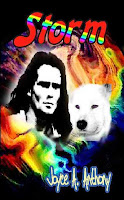
Author of STORM

[Author's note]
Storm is a spiritual fantasy unlike any you have ever read. It will change how you look at the world. He's back and the world will never be the same. Are you ready for Storm?

"Who he is and why he's here is a mystery, even to Storm--a mystery that can only be solved within the whirling rainbow. As he searches for answers, he touches the lives of society's forgotten and when he finds his identity, nobody is left untouched."
What do a prostitute, an abused child, a disillusioned minister, a Vietnam Vet and a homosexual have in common? These and many others find their lives changed when they meet Storm and his companion, an amethyst-eyed dog named Maggie. As you follow Storm on his journey to discover his true identity, you will meet many of society’s forgotten people. You will laugh, cry and get angry—whatever the emotion, you will feel deeply. When Storm realizes who he is and why he is here, the world is completely changed and not one soul remains untouched. Upon closing the covers of this book, you will see the world around you in a far different light and find yourself wondering—is it really fiction?
http://www.starpublish.com/joyce-anthony.htm
http://amazon.com/Storm-Joyce-Anthony/dp/1932993746===================================================================

Joyce,Thank you so much for offering to stop by today on your month long blog tour. I am delighted to have you take the time to answer all of our questions. I want everyone to get a good look at what went into writing STORM a highly recommended, critically acclaimed novel. Classified as an inspirational

Billie: My picture of a thunder storm crosses my mind every time I think of your title--How did you arrive at that title for your book - I realize it is the name of the main character - and that just raises the next question.
Joyce: It was named after the main character. I find storms beautiful--powerful and full of energy. They light up the night. Much like my main character. Originally, I was going to title it The Whirling Rainbow, but it just didn't feel right, naming it after the MC did.

Billie: Storms and Rainbows seem to hold a huge place in your life – do you have any life changing experiences that make them so important to you? Or can you think of a reason why they seem to be so important/ influential to you?
Joyce: My earliest memories of storms are sitting on the porch with my grandmother and watching them. She loved them as much as me. I've never had any fear of storm--they seem to energize me yet calm me. As for rainbows--I've always seen them as a sign of hope. A promise. Sometimes in life, all you have to get through is hope--and part of me wants that to be what my writing does--bring hope to someone who may need it.

Billie: When you say you sat with your grandmother watching storms and loving it I’m reminded of sitting with my Grandmother and Grandfather summers on their farm watching those storms he loved them too…once the lightening struck so close Grandpa flew out to the barn to check on the livestock because he knew it had to hit something. It did a mother sow had given birth to fourteen pigs a day ago – all of them were dead but two, my sister and I bottle fed until they could eat on their own. Weren’t you afraid when you named your book Storm people might be put off by the title – thinking in terms of “The Storm of the Century,” type book…or do you think the cover would sufficiently warn them that it is not of the genre?

Joyce: Poor piglets :-( The thought did cross my mind that people might be mistaken about the content of the book--but I knew the cover would portray something different and was hoping that would draw attention. I wasn't sure exactly what would be on the cover, but I knew Storm's picture would be.

Billie: I know there have been many things I’ve learned that I only noticed I needed to know after the fact. And the reason I did that job or learned that lesson or skill was to deal with what was looming ahead of me or currently taking place in my life. For instance the caregiver training in various nursing homes that I had before my mother needed me to perform those same duties for her. Was there anything in your life that you feel may have prepared you to write STORM? Is the track Storm is following meant to be a railroad track or is it some other type of pathway he must search out to walk?
Joyce: I believe my Psychology training slightly--and just the variety of people I've come into contact with over the years more so--helped me to understand the inner workings of the minds of my characters. This understanding made it possible to allow them to express the full depth of each of their characters.
Literally, it is a railroad track. When I was a little girl, I'd look down the track and wonder what it would be like just to follow them to wherever they went. Another writer, hearing this, asked me what was at the end--that is what pushed me forward to finally put Storm on paper. He is also following another kind of track, however, this is one of self-discovery and self-acceptance.


Billie:
How did you choose that name for your character?
Joyce: I didn't--Sam did :-) Actually, the characteristics mentioned above made me think of the name. Sam named him Storm because that is what brought him to the lighthouse--so it just "fit".

Billie: What about the dog—my daughter has a Boston terrier she just got, she named her Maggie. That sounds like a countrified, down home kind of name—is Maggie meant to come off that way and how did you find a name for her?
Joyce: I first called her Miracle--but she didn't like that name and told me she needed a new one. I wanted a name that conveyed kindness, loyalty, steadfast love--Maggie kept coming to mind. I asked on one of my writing groups for suggestions and Camilla, a sweet lady mentioned she thought Maggie was perfect. I still wasn't sure until I remembered someone they called Maggie--and her real name was Magdalena--it seemed perfect--so Maggie stuck.

Billie: .I can’t wait to tell my daughter how you chose your Maggie – in my mind I see a rag muffin doll — but now with your explanation I see more. Would you say your book is a Christian inspirational book ?
Joyce: I like to think of this as spiritual, inspirational from a Christian viewpoint. My faith is evident in this book, but I want people from all religions to see the value in it.

Billie: Can you tell us what breed of dog you envision Maggie, a character in Storm, as being and why?
Joyce: She's a pure white Alaskan Malamute. I find this breed of dog to encompass all the character traits of Maggie--dependability, loyalty, gentleness. They can deal with hardship and still come out sweet-tempered.

Billie: Has this book been rambling around in your mind for a while or did it just jump out and ask to be written now? In either case what was your process to get it down on paper?
Joyce: I always go over and over my writing in my mind before a word ever reaches the paper. I have often heard other writers talk about the story being written in their mind first--I actually "see" movies play out in my mind of the basic details. By the time I start writing, I have the basics clear and organized--it's those darn surprise characters that throw me--they pop up and I get to "meet" them on the spot!!
I must say, I could not have NOT written this book--the characters nagged at me, entered my dreams and thoughts during the day. They wouldn't allow me to ignore them.

Billie: When you say the book rambles in your mind before you write – do you take notes so you don’t lose any of those threads that turn up? Some authors will take copious notes before they begin a project — was it that way for you with Storm – if not do you believe in outlining?
Joyce: I never outline. I may write a word or two to remember something, but never complete sentences. The story basically plays itself out in my mind like a movie--and that sticks with me.

Billie: I find the whole movie in your mind kind of thing a unique take on writing. Many authors say their characters pop into their heads with scenes or parts of their personalities etc, they want written. But this is a first for the visual story telling. Would you say that your story is complete when you see this video in your mind? or is it more like a movie trailer with chunks of scenes that you need to connect with your own magic of pen and paper?

Joyce: This wouldn't be the first time someone said my mind worked uniquely :-) The story actually unfolds completely, ready to be put onto paper. Often it is written as it is playing out in my mind and I am as surprised as if I were watching a movie on the screen.

Billie: Mary is the first person we meet in your book once Storm and Maggie become a team. Can you tell us a little about her and why she found a place in this book where she did? Is she a stage setter, a precursor of things to come? Is she and women like her Storm’s mission in life?

Joyce: Mary is a woman who went from an abusive home life to an abusive relationship. She has given up hope and earns a living as a prostitute--figuring men have always taken that from her so she might as well get paid for it. This is her one and only source of holding power in her life. She has lost all hope. Storm's mission includes women like her, but it is wider. His mission includes all who have lost hope, all who are basically good people, but society may have lost track of that because of outer appearance.


Billie: Who is your most influential person affecting your writing? why?

Joyce: Hmm..this question can be answered two ways. When it comes to actually believing I could become a writer of books and sharing my writing with others, I owe it to two very dear friends who believed in me long before I believed in myself--I've mentioned them in my acknowledgements.
If you are referring to authors, I would have to say Richard Bach and Rod Serling. Both challenge their readers to think and examine both the world around them and the world within. I feel that with Storm I have incorporated a little of both.

Billie: Somehow I never thought of Rod Serling as being a mind boggler – and yet now that you mention it – he really has the mind of a genius to come up with some of his plots. Do you see any relationship or connection between him and Stephen King – as far as how their minds work to make plausible the implausible? — Or would you say Rod and Richard are far removed from the mind of Stephen King?

Joyce: I really don't see Stephen King in the same category as the other two--he writes horror, plain and simple. There is no need to stop and think, you just read. The other two make it impossible not to think. You finish a story and either find yourself thinking "wow" or you start wondering what is going to happen around the next corner, where you might find yourself.

Billie: I understand what you say about Serling and Bach. I think they both give reality a twist and the what if sits in your mind. Are their any current authors that do that for you? Are your new books as influenced by Serling and Bach as Storm was?

Joyce: I don't believe I've come across any other authors that influence me the way these two do--they are both literary geniuses. I believe The Trees Remember may show some influence, but at the moment I'm not sure about the other two.

Billie: In Storm the character of Storm seems to be very intuitive and , I hesitate to use the word psychic, but for the purposes of clarity – that is what I’ll use — does this ability to ‘see’ parallel how you feel perhaps a bipolar child sees also? Is this something that you feel you may have picked up from Serling or Bach as that air of their unique brand of story affecting or perhaps causing the reader to question what we ignore or don’t listen closely enough to in our own lives?

Joyce: I don't believe Storm's ability to sense that beyond the norm parallels a bipolar child's type of sight. Storm's is more of seeing what is beyond the "norm", while that of a bipolar child is basically seeing what is there, but from a different angle than others. I believe we all have this innate ability to see what isn't readily apparent, most just have pushed that aside in favor of what can be readily proven, and therefore understood. While I believe both Serling and Bach believe this way, this one happened to be based on my own belief rather than either of their influence.

Billie You already have another book in the works - is a continuation of where this one has taken you - or is going off in another completely different direction?

Joyce: Spirit of the Stallion is completely different than Storm, as are the two projects I have planned after that. I am a very eclectic writer.
The next one is nonfiction inspirational that tells the story of a bipolar child. Then I have The Trees Remember, which will be a\n historical paranormal and The Gospel According to Rex, which promises to be a fun book to write--it will be targeted at young readers.

Billie: These sound positively fascinating – can you tell us a little about Spirit of the Stallion? I can also imagine the world of a bipolar child – what a horrific burden for a child. — The titles are fascinating. How did you come up with these titles — ??? Some authors don’t find their titles until the book is done. What is your process for finding Titles? Or is that where you start?

Joyce: First, titles--I've never been very good at them until lately. They seem to pop into my mind, usually at the end of the writing. For some reason, these seemed to "fit" from the start. The Gospel According to Rex is actually only a working title--the others are set.
Spirit of the Stallion is my son's story. He has experienced symptoms of bipolar disorder since his first night terror at the age of one week. He has fought hard to get where he is now--but he's in a very wonderful spot in life. I'm hoping other parents going through the tears, fears, anger, etc... will realize there is a proverbial light at the end of the tunnel--with enough patience, fighting and love.
Many books on bipolar children don't cover some of the most common aspects--how to deal with the police and landlords, how to deal with two left socks, how to answer people in public who are full of advice on what they would do if it were their kid... Spirit of the Stallion will include those things as well as the story.

Billie: Spirit of The Stallion, I know your son is old enough and wise enough to have read your work. He seems to understand things on a level most children never reach. .Does he know this book is about him? How does he feel about that? I also know that he is an artist, and very good at what he does. Do you think his Bipolar problems has sharpened his ability to see and create what he sees, a sort of creativity edge?

Joyce: Shane certainly does have a spiritual wisdom most of us never reach. He has known this was going to be my next book for some time now. He says he wants me to hurry up and get it written because he feels he needs to read it. His inner need to read this is almost as strong as my inner need to write Storm--I believe this book will be led by a hand outside my own--to help Shane understand what he needs to.
Being bipolar does seem to help creativity. I'm not sure it has anything to do with genes, however. I believe the enhanced creativity comes because the bipolar mind views the world from a slightly different angle than the rest of society--and it is that angle that shows in creativity.

Billie: Were you trying to instill in the minds of those in situations similar to Mary and perhaps Shane and the others in your book that they are not alone, that they only need to seek the counsel of organizations that are out there and their higher power, be that God, the Great Spirit or some other Deity? Or is this just something that I feel, as a reader of Storm, which you hadn’t really planned on showing?

Joyce: I believe you hit on my point exactly :-) I believe a person needs faith in a higher being of some type--for me, it is God, for others that being goes by a different name. It doesn't matter what you call this higher power--it's the faith that is important.

Billie: Is there anything you'd like to tell your readers either about this story - or your next one?

Joyce: I would like to mention that part of the proceeds of Storm will be donated to StopItNow, a group dedicated to preventing childhood sexual abuse. Whether a person buys Storm or not, and you know I hope everyone does, I'd like to ask that you check out www.stopitnow.org and see what they are doing. They have a whole different approach to this very important subject.

Billie: I think it’s wonderful that you are donating part of your proceeds to StopItNow…Can you tell us a little more about this project – it is national in scope – how can others get involved with it – besides buying your book I mean? (which is an excellent idea – then you get a great read and the StopItNow Organization gets a donation.)

Joyce: Naturally, I'd love having people buy my book :-) StopItNow approaches the subject of childhood sexual abuse from the perspective that prevention is much better than treatment after the fact. They focus on training programs to help caregivers and parents, and anyone else involved with kids, to see where the roots of abuse start--to know when there may be a problem and avert it before it happens. They also work with would-be molesters to help them keep from harming a child.
This approach, starting from the very root to prevent, is a novel approach that seems to be working. Anyone wanting to see exactly what is being done and how they might help can visit http://www.stopitnow.org

Billie Will Spirit of the Stallion, your next book, be earmarked to benefit some charity as Storm was earmarked to help “Stop it Now”? And a question about bipolar children, this seems to be a growing problem in the United States or is it a problem that has just become more recognized and diagnosed with people being trained to help those who suffer from it? Also, is there any connection between Autism and Bipolar cases. Is Manic Depression the same or just another disease altogether?

Joyce: Yes, Spirit of the Stallion, as well as all my other books, will all benefit some charity. I have yet to decide which one, but it will relate to childhood bipolar disorder.
Bipolar disorder is the same thing as manic-depression--it is just a more modern term. While some people with this disorder also have Autism, the two are separate disorders and not related.

Billie: Where do you see your career going say five or ten years from now? Both the big dream and/or the reality? I believe you have found your niche and I hope much success for you and your talents are ahead as I’m sure they must be.

Joyce: You know, I haven't thought about the future in terms of career. I see having written and published four books within the next five years. I'd like to have sold enough to buy a small house for my son and critters. Beyond that, I'm open to wherever life takes me--it's all an adventure.

Billie: What is your writing day like? Is it a planned time frame? Is it just happening when the mood strikes you?

Joyce: I don't have any set schedule for writing. With homeschooling and taking care of all the critters, it is a matter of writing a few words here and there--whenever there is a free moment. There are often days on end when I don't get a word actually written on paper. Luckily, I write everything longhand first, so bus rides, waiting rooms, etc... often see me with pen and paper in my hand.

Billie: So, you don’t set aside so many hours a day to write – I’ve heard this is the only way to get on target and yet you seem pretty prolific doing it your way. “A Picture is worth a thousand words,” does your photography feed your story idea bank – does it influence pictures you take or the other way around?

Joyce: My photography has actually given me ideas and stories. I'll be out photographing this or that and see something that catches my interst--before I've finished the pictures, I have a story formulated. I am a very visual person--I "see" stories in my mind, so it makes sense to me that the photos would create the stories. I'm a firm believer that every object, every person has a story to tell. We as writers just need to look and listen to find it.

Billie: I know that you are a very busy person and I appreciate you taking the time to answer all our questions. If I might ask, you also write articles how does this feed into your fiction, or does it? Where do you get your inspiration for writing articles?

Joyce: My articles are written by what the situation calls for at the moment. I don't need the same amount of involvement or emotion for them as my fiction. The two are completely separate in my mind.

Billie: One last question about your articles – I assume they pay the bills so that you can do all the other things that you do – when you’re novels start bringing in the money that can sustain your household, will you continue to write the articles? If so what do they bring to your life that perhaps fiction writing doesn’t? One other question, do you use the research that you do for your novels as fodder for your articles – or does that perhaps influence your writing to some degree – or are they both such different realms that neither feeds the other?

Joyce: My non-fiction and fiction are completely separate from each other and really don't influence each other. I would love to have my books make enough to support us, but I will always write certain articles--such as those regarding bipolar disorder and those for WINGS. There is a place for both in both the world and my life.

Billie: What about your photography? I know this is about your books, but it’s about you too and you are a multi-talented person and I’m curious if you sell your pictures, use them with your articles or sell them as a freelance photographer – or would you consider that if you don’t now? I’ve seen some of them they are very good. The ones of animals…is it hard to get animal shots as good as yours or is it you just have a knack with animals?

Joyce: Thank you, Billie. I am always open to selling my photography work, but that hasn't happened yet. I concentrate more on that aspect of my life in the warm months. I understand animals and I believe they sense that--except those darn birds, they won't cooperate with anything :-)


Billie: Joyce, it has been such a pleasure to talk with you and have your generous and thoughtful answers to some burning questions I’ve had about your writing style and content.

Thank you for spending time with us and for answering all these questions. I’m sure the readers will be grateful too for your time and consideration.
Billie A Williams
www.billiewilliams.com
==============================
To contact our guest author "Joyce A. Anthony" and be sure to visit her website for more information and a link to order your copy of her book now.

Saturday, April 7, 2007

Dictionary The Devil is in the Details

Billie A Williams ©2007
Dictionary – does that word throw you into a tail spin or are you ready to sit down for a good read? This morning when I went to look up a word that just happened toward the back of the dictionary (tribute) I wanted to know the meaning for a project I was doing. Anyway, I opened my concise Oxford English Dictionary (this is a one volume tome that you can read without the magnifying glass that comes with my two volumes, slip cased tome.) This one has plenty in it, just not everything. In the back of this delicious piece of writer’s arsenal were some things I never bothered to look at thus far, called Appendixes —what could they possibly have that would not be in the dictionary right?

Well—an hour later I’m still enjoying these delights Collective Nouns — where you will find such things as a group of apes is called a shrewdness, a group of bears a sloth or sleuth— wouldn’t that be a quirky red herring for your mystery? A group of boys = a blush. Ha, not in this century. A group of cats a clowder or glaring or a group of wild cats would be a dowt or destruction — they don’t know my Lady Slipper she is a destruction force of one. Or did you know that a group of nuns is a Superfluity. Love that one. Wonder if Janet Elaine Smith thought to use that in her book Old Habits Die Hard, one of her Patrick and Grace Mystery Novels?

The Collection of Collective Nouns, while entertaining, is very useful for trivia contests, writing your novel or poem and more. These particular ones above are noted in the Concise OED are from the 15th century Proper Terms Book of St. Albans by Dame Juliana Barnes.

The list goes on but here is just a glance at what those appendix hold:
1. Countries of the world with capitals, square area, population, currency unit
2. Prime ministers of Great Britain, the United Kingdom, Canada, Australia, and New Zealand and Presidents of the USA.
3. Kings & Queens of England and the United Kingdom
4. Weights, Measures, and notations with conversions to metric, Fahrenheit and Celsius temperatures, metric prefixes with meanings and power notations.
5. Chemical Elements
6. The Greek Alphabet
7. The Solar System
8. Collective Nouns
9. Types of Language; formal, informal, archaic
10. English in Electronic communication – Abbreviations used for text messages cell phone or computer.
11. Guide to Good English

All of this was fascinating, but then words are my stock in trade. I love them. That’s why Richard Lederer is such a treasure to me.

Then I decided to take a look at the introduction. I always read the introduction, preface, prologue in the front of books now. I never used to. I thought they were a waste of time. They certainly are not. The introduction to my Concise Oxford English Dictionary is a plethora of great information from how to use the dictionary (everyone knows that, right? You may want to think again) the way it is set up, the uses, and method of the whole book— to trade offs between Canadian English and American English; gas for petrol, braces for suspenders etc. There are 22 pieces of information that are contained in each word and definition if you understand what is presented there. My new rule – Never skip an Introduction the author or authors put it there for a reason.

And Speaking of writing - guess who is a guest blogger right here next week - Friday the 13th of April ? - my good friend and fellow author Joyce A. Anthony. She will stop by to talk about her new critcally aclaimed book that is taking the world by storm -- STORM. You won't want to miss her visit. Be sure to come by April 13, 2007.


Friday, April 6, 2007

Sharpening My Pen With Maple Sap

I know that sounds silly - but it's the truth. This morning as I was looking out my window on this unusually blustery and cold spring morning the birds were flocking to the feeder and the suet in record numbers. The poor little guys must have been freezing. The Gold Finch are molting and getting spring yellow wardrobes and that makes them particularly vulnerable. I feel sorry for them.

I started writing about this in my journal (my three long hand morning pages everyday) when I noticed an odd phenomina. There were frozen icicles of sap dripping from the soft Maple tree that stood a few feet from the bird feeder. The black capped chickadees and the rose breasted nuthatches took turns drinking the frozen brew. The chickadees had to hover like humming birds, the nuthatches just perched upside down and nibbled at leisure.

The three families of woodpeckers (downy, hairy, and I'm not sure what the other is, small, medium and large all look pretty much the same - except to another of their specific species I'm sure.) were joined by a yellow bellied sapsucker all taking turns on the suet or hammering the tender maple branches and I knew instantly who had wounded the Maple tree causing the sap to flow on the days when the sun shines. Even if the wind and the temperature are cold...the warmth of the sun encourages the Maple to do what maples do. The woodpeckers do what woodpeckers do and the result is a special treat for the other birds. Mother Nature is amazing.

So, my writing practice included lessons in letting go and letting nature take its course. Sometimes that is necessary in our own lives too.

Enjoy your Easter break - hope your holiday - if you celebrate is filled with love, health and prosperity, and do take time to look out your windows and be amazed.

Thursday, April 5, 2007

Are you a gardener?

Because it's spring - I decided to give you a few gardening tips - and we can relate it all to writing later.

6 STEPS TO A PICTURE PERFECT GARDEN
by Billie A Williams © 2006

Sowing your rows, as my grandfather used to say, straight rows make an easy hoe, and the sight is definitely pleasing to the eye.

1. Start by putting a marker where your row will begin and another where it will end. Run a string between them as a visual aid to making nice straight rows.
2. Use a grub hoe, or the handle of your rake or regular hoe handle to draw a planting furrow between the stakes under the string. Adjust your depth to twice the thickness of the seed you are planting.
3. Sow the seed, by shaking it from a small cut across the corner of your seed packet. I usually plant thick and plan to thin because my grandfather always cautioned me to “plant one for the birds, one for me, and one for or against the chance of a dud seed.” (Jerry Baker, America’s Master Gardener, recommends using an old salt shaker to shake seeds from to aid in even distribution.)
4. A Hint from my neighbor in Bayfield, Colorado a Master Gardener herself—Bea Bartholomew used to draw the furrow and then drizzle water into it to soak the ground before placing her seeds in it. Cover the seed either by dragging the hoe corner across forcing soil into the furrow, or use your hands to push soil over the seed to the proper depth, being careful not to let stones, or clumps of soil cover the seeds. Her garden was always beyond fabulous.
She also watered each row as she finished planting it.
5. If your soil is heavy you may want to use a week tea to water the seeds [Weak Tea Recipe 1 twice used tea bag, I tsp liquid dish soap, to one gallon of water. Steep the tea bag in the soapy water mixture until the water is slightly colored. ] This weak tea solution will help the seeds germinate but will also keep the soil from becoming hard packed and crusty giving the seedlings a better chance to put down roots and push through the top soil layer.
6. Keep an eye on the new seedlings. Thin them as necessary to be sure they each have enough room to mature properly.

Sunday, April 1, 2007

Playing Tag

Playing Tag is carefree, exhilarating, with no deadlines, no expectations you just play the game -- racing against yourself to keep from getting tagged - suddenly you're it. Now what? Can you relate this to your writing?

You've read, you've studied this was the carefree, exhilarating part. There were no deadlines or expectations. It was just you exploring, but all of a sudden you are out there. It's your turn, it's your words being loved or rejected, shoved back into an SASE (self-addressed, stamped, envelop) to be returned to you along with a standard form "Not for us." A rejection and you are crushed. You decide this game is not for you. You decide you aren't tough enough to chase after someone and tag them only to have them say - I'm on the goal you can't tag me - Your work is no good we don't want it.

Something inside you won't let you quit. It's like Issac Asimov said, "I write for the same reason I breathe, for without it I would die," and you know it's true of you too. You chase, once again hoping to catch that brass ring, that illusive editor/publisher that thinks your work has that something special enough to be polished until it glows by the editorial staff and you...you open the letter with trepidation, heart palpitating-- Dear Ms....We are delighted to offer you a contract for.... Your eyes blink back the tears and you read it again TAG YOUR IT! You did it, they want your story. You won't believe it until you read the contract, sign the contract send it in and have a signed copy come back in the mail to you.

Now it's time for the happy dance and cyber chocolates and champagne - you are IT you have been TAGGED. Perseverance has finally paid off. And that's what it takes is dogged perseverance. Once again you dig in and begin to write and send, and send and write and write You are a writer it's been confirmed and you have the contract to prove it.

A writer with verve, wit and chutzpah is soon to be a guest blogger at Printed Words - Joyce A Anthony author of the critically acclaimed novel STORM is to be our guest blogger on APRIL 13.
Don't miss her interview right here - find out how Storm came to be, what makes Ms. Anthony tick, and more.