Showing posts with label beginning writing. Show all posts

Monday, December 19, 2011

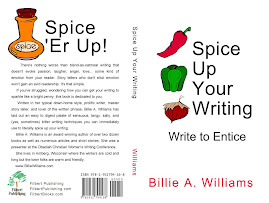
Spice It Up, Creativity From The Kitchen - Spice Up Your Writing, Write to Entice

Order Your Copy Today
Instructor: Billie Williams. There's nothing worse than bland-as-oatmeal writing that doesn't evoke passion, laughter, anger, love…some kind of emotion from your reader. Story tellers who don't elicit emotion won't gain an avid readership. It's that simple.


If you've struggled, wondering how you can get your writing to sparkle like a new penny, or a just cleaned window, learn to see everything as a metaphor for your writing. Start by looking in your spice cabinet, or your herb garden with a fresh perspective.

Garlic, Life Saving but distancing

Easier to write from this perspective but it puts your reader at arm's length--remember readers want to feel, experience, get to be friends with your main character so they can help him/her escape the villains wrath.

Sage, Advice
Sage has several meanings from wise advice to healing properties - what does sage mean to your story? We'll explore.

Basil, The flavor of language, dialect, cultures
Ah Basil - language - should you use dialect in your dialogue? How do you show culture if not through language?


Lavender, Relax feel the flow--in sync [Chat here with a book giveaway as well as a book giveaway at the end]In the flow, relax, meditate let things go where they may--don't lose site of the big picture but let your writing flow with a rhythm and cadence only you can create. Here's how.

Mace, Caustic, self defense, breaking the rules

An irritant chemical, a heavy club with a metal head and spikes - what could these possibly have to do with writing you ask..follow me--it's all about rules.

All Spice, Apple pie or American Graffiti

All Spice is for cookies and more from on genre to another all spice imparts its unique twist, it's unique flavor to your manuscript--your voice. We'll explore more.

Appendix: Handouts, "How to Hook A Reader", "Beginnings to the Work Day By the Masters"

WHEN: Jan 2, 2012 - Feb 19, 2012

COST: $15 for Premium Members

$25 for Basic Members

Cancellation policy: Registrations are non-refundable except when the workshop is cancelled by Savvy Authors.


REGISTRATION: Click Here to Register (Members will not receive member rate unless logged in.)

Saturday, July 30, 2011

Choices for Painted Pony and other considerations

Hi Readers
 So far we have Jamie and her painted pony at a scene that hasn't yet been described by the author. I figure we have at least 3 choices. Here are the fourI'd like you to vote on.
 What Jamie encounters when she comes around the corner is:
1. A tape recorded trickery that used a trained horse to deliver her to this spot...someone with a sinister motive awaits her.

2. There is a crying baby, the mother is injured in a fall from the horse - the child is crying the mother is bleeding profusely from a gash on her head.

3. A Baby is discovered, surrounded by wolf cubs and a colt - the baby has a note pinned to his/her shirt.

4. a vision - a council fire with elders chanting and singing with the drum - they summoned her to save the Indian burial grounds from developers. Her deceased father is among those present at the council fire. The Painted Pony was sent because her father knew her love of animals would win over anything else going on in her life.

So there are your choices for me to continue - send me an email at Billie and tell me what you think.
Then I will continue with the next chapter next week.
Thanks!
 Search Amazon.com for Watch For The Raven
Billie


Sunday, January 23, 2011

Welcome to the Write Place, Writing Prompts to Writing Tips


Welcome to the Write Place
@ The Write Time for the Write Reason
Williams’ Winter Write-a-thon Workshop
“Writing Prompts to Writing Tips”
It’s Write For You!

February 1, 2011 Marks the first week of Writing Prompts to Writing Tips a new 10-week, online, writing course that will give you momentum and motivation to begin that long dreamed of career as a writer. [This is an open ended course that can begin at anytime and work at your own pace. The lessons will be delivered one a week after sign up.]
Billie A Williams multi-published, award-winning, and best-selling author of over two dozen mystery novels has taken parts of her six books on the art and craft of writing and turned them into a course to help you get started, or to continue to tweak, your writing career.
“Right from the Welcome letter to the sign off you are in for a busy work-a-thon or Write-a-thon as I like to call it.” Williams says.
 “Can you picture using bubble gum as a metaphor for writing,” Williams does. “Have you ever thought what the wide space between someone’s front teeth might mean for someone besides their orthodontist?” Williams does.
Here is a sample of the things you will be working on.
 Writing Wide, Exercises in Creative Writing (Williams’ first book on how to write in this series) provides some unique ideas to grow your mind from ordinary thinking to creative thinking in lessons one through four.
Lesson One: Wide Spaces Between the Front Teeth
Lesson Two: Writing Challenges—The idea—The first Sentence
Lesson Three: Wide Lines of Wide Ruled Paper
Lesson Four: Corralling the Wild Stallion in Your Writing (wimpy verbs, wasted Adverbs and  Adjectives,  and worn out words in cliché’s etc.)
Lesson Five: Bee Balm—the hook is from the book Spice Up Your Writing, Write to Entice
Lesson Six: Create Characters That Live and Breathe and Your Readers Love from the book
Lesson Seven: Style, What Will You Write? From the book is A Writer’s Vehicle, Henry Ford’s Way
Lesson Eight: Wide Brush Strokes from the book-- Writing Wider, More Exercises in Creative Writing
Lesson Nine: Unique Accidental Sleuths, The book title Whodunit? A Mystery Writer’s Primer
Lesson Ten: Is simply a Wrap up with 12 Steps for Writers. Conceive it, Believe it, Achieve it!

And there will be handouts available to further enhance the experience. For those who do better listening to the lessons, there will also be bonus audio recordings of the lessons available for members as well.
For more information go to http://www.writingwide.com

ABOUT THE AUTHOR:
Best-Selling, Award winning Mystery/Suspense author Billie A Williams is a fiction, non-fiction and poetry author and has won numerous contests for her short/flash fiction stories, essays, and poetry. Currently she has over two dozen books published. She is published in various magazines such as the literary magazine Thema; Guide, a Magazine for Children, Novel Advice.com, Writing Etc. WritingNow.com, and Women In The Arts newsletter as well as Sister’s in Crime, to list but a few.
Williams is currently a member of The Wisconsin Regional Writers Association (WRWA) Upper Peninsula Writers Association (UPWA)National Association of Women Writers (NAWW) Sister’s in Crime, Women in the Arts, Electronically Published Internet Connection (EPIC), Society of Children’s Book Writers and Illustrators. (SCBWI) and Children’s Book Insider, and the Working Writers Coaches Club. Visit her at her websites  www.billiewilliams.com or http://writingwide.com and sign up for her Newsletter  and/or  Billie-Williams-Mystery-Book-Of-The-Month-Book-Club on her website.
Find out more about me and the books I write at my website at www.billiewilliams.com
If you have any questions, send her an email at billie@billiewilliams.com
Williams says she is more than willing to speak to your group – if you have an idea for a program you’d like presented, please do not hesitate to write, or email.
P O Box 134
Amberg, WI 54102


Friday, February 5, 2010

Writing and Farming How are they alike?


I've been a long time admirer of Beth Erickson and her writing - and her news letter Writing Etc. She is a publisher, writer of fiction, non-fiction and an amazing copywriter - She always has some good advice for us. Today, I'd like to share an article comparing Writing and Farming. I'm sure you will find it interesting.
Beth is the name behind Filbert Publishing and my latest book A Writer's Vehicle, Henry Ford's Way due to release later this month.
Enjoy her article and consider signing up for her newsletter.
=====
Freelancing Like a Farmer

Beth Ann Erickson

I began my illustrious freelance career with visions of tweed coats, elbow patches, cigars, and pensive photos. My mind’s eye saw a cluttered office, checks strewn across my desk, and waking to one illuminating thought after another. I believed I’d tap at the keyboard, mail queries, read my articles on glossy paper, and assignments would flow like water.

Small problem with that scenario. Tweed coats don’t look good on me. I don’t smoke, never have. And I usually wind up looking goofy in photos, no matter how hard I try to strike a pensive pose.

Ah, but my desk is cluttered. I do occasionally find a stray check in amongst the mounds of papers. But illuminating thoughts? Bah.

There’s a fundamental problem with my original scenario: my freelancing model missed a crucial element necessary for financial success.

For example, the cash I expected to earn from writing articles just didn’t add up to the numbers I hoped they would. Seriously. Spending weeks writing, rewriting, and finally submitting an article, only to reap a whopping 25 bucks just didn’t pay the bills.

Then I decided to write books. Unfortunately the small royalties barely covered my promo expenses. It’s exciting to sell books, but we needed some large volume sales to make this endeavor financially worthwhile.

How ‘bout publishing? Again, after wholesaler discounts, distributor expenses, author royalties, and postage, we’re talking some pretty slim profits. And again, we’re talking volume sales to lower expenses and prop profits.

But then something magical happened. I discovered the wacky world of copywriting.

In case you’re unfamiliar with copywriting, a copywriter is a master persuader. They write ads, direct mail, sales letters, and such.

And (little did I know) proficient copywriters earn a lot. World Class Copywriters earn astronomical fees.

Copywriting isn’t difficult. But there are definite tricks to the trade. And you can cut your learning curve by years if you receive proper training.

But here’s where things really get cool.

Turns out these new persuasive skills made it far easier to write awesome queries. Boom. Article sales jumped.

Next, I revised the sales copy for my books. Boom. Another jump in sales.

I applied “copywriting language” to everything I wrote and kaboom… even more sales, more exposure, new readers found me.

And I haven’t even gotten into copywriting as a business: writing for clients turned out to be quite lucrative as well.

Now, I love to write. It’s my passion. There’s nothing like receiving a complementary e-mail outlining how something I’ve written has made someone else’s life easier, gave them hope, helped guide them through this wacky profession.

On the other hand, I hate marketing. It sucks. One rejection and I’m down for the count. At least for a while.

But by combining my writing skills with copywriting psychology, my self-promo time is automatically sliced in at least half because I’ve learned stealth persuasion to draw clients my way.

So now, clients (and publishers and editors) are attracted to me rather than my gunning after their very fractured attention.

So… where does the “farming” come in?

Simple. Rather than concentrate on one aspect of your writing career, think like a farmer. Plant many seeds and watch them grow at different rates.

Instead of becoming an article writer extraordinaire, write articles when the spirit moves you. Submit them when they’re polished. Start writing the novel that’s burning your heart. Eventually publish it. Research a nonfiction title. Write ad copy.

You can even take this further. I speak to the local high school. Elementary schools, too. How ‘bout local organizations and the Chamber of Commerce? Once a businessperson sees you in action, they’ll be hooked.

Just keep planting seeds (remember, you’re a “farmer”) and before you know it, you’ve got more paying clients than you know what to do with.

But copywriting’s the linchpin that binds all these endeavors.

That’s because effective persuaders control their destiny… and their income.

So here’s to effective “farming” and inevitable success.

~~~

Beth Ann Erickson is the “Queen Bee” of Filbert Publishing. She’s also the author of numerous titles as well as the Creative Mindset Newsletter. Pick up the first seven copies today here. She’s also a busy copywriter, speaker, and publisher of Writing Etc., the free e-mag for writers.

Tuesday, June 23, 2009

Rainbow Morning


First a quote that slipped into my inbox this morning:

"Three grand essentials to happiness in this life are something to do, something to love, and something to hope for. "
- Joseph Addison

I wish for you all of the above blessings. This morning I was busy writing in my journals - we had a high fog - nothing major. A very pleasant morning. Suddenly the sun was peeking through and everything looked spring/early summer abundant. Then out of the sun shine, a sun shower - straight down beautiful rain. I had thought I heard thunder in the distance earlier but the sky was cloudless - as far as I could tell.

The sun shower became a little heavier and finally the sky became darker and turned into a downpour. I raced from my sunny kitchen window to shut windows on the back porch - there-- immediately west in full view was the most amazing rainbow I had ever seen.

I was in awe - as I traced the arch from one side of the horizon to the other - I noticed the arch over a hole in the deep gray clouds. There to my amazement was clear, robin's egg blue sky, an electric white cumulus cloud top, framed by the gray and all of it arched by this huge rainbow.

Could you ask for a better promise to start a day then that? I still can't believe my eyes - I was too amazed to run for a camera, I figured by the time I got it set up--the view would be gone.
Have a rainbow and happiness sort of day. Thanks for letting me share my joy.

Monday, October 20, 2008

Don't Wait For Your Ship to Come in Swim out to it!


In my morning reading today I came across this quote by Jonathan Winters: "If your ship doesn't come in, swim out to meet it."
There was another a day or too earlier that said something, "Things may come to those who wait, but only the things left by those who hustle." Abraham Lincoln.

In other words, the only thing that will create success, or create that book you've been waiting to write, or create some other printed words you dream to have written, is ACTION. There is no way around it if you don't put your butt in a chair and write - you will never publish a word. You need to banish all fear of failing, of making a mistake -- mistakes are the lessons of life.

This Frank and Ernest cartoon strip says it all. Frank is at the counter at an employment office he has a long long sheet of paper he is apparently reading from to the guy who is taking his application. The caption says--"I don't have any formal education so I brought you a list of the mistakes I've learned from."

Feel the fear and do it anyway is almost a buzz word nowadays, but it's absolute truth. Do not be afraid of mistakes, no one is perfect. Perfectionism will stall you in your tracks. Not that you should adopt a careless, reckless, not-give-a-darn attitude. You should do the best that you can do with what you have at this very moment and let the rest happen.

"You can never learn less; you can only learn more. The reason I know so much is because I have made so many mistakes," says Buckminster Fuller (a mathematician and philosopher who never graduated from college but received 46 honorary doctorates.

Imagine!
Write Like The Wind
Billie
Tung Umolomo
South African Adventure
ISBN 1-4237-0092-6
www.billiewilliams.com

Monday, July 7, 2008

B is For Basics--Background is Basic


You can’t beat a good character for making sure your readers get involved in your story. Not only that, but it gives you proper motivation for your story goals.

For instance, if you use the zodiac signs to chart your character traits—the simple ones that give general traits without worrying about sun signs, moon position and all that. You can find the perfect character with the traits you need to give your protagonist so she can act in appropriate ways. And you can find the perfect opposite to drive her crazy, create the conflict in a romance and/or the angst with the right villain.

While your protagonist is water (Pisces, Cancer, Scorpio) your romantic interest/or even your antagonist could be a fire sign (Aries, Leo, Sagittarius). The traits of those people, both strengths and weaknesses should give you enough individual conflicting traits to weave a great story.

Once you determine your characters’ Birthdate, you can dig further to define him or her. There are references to birthdates tied to tree charts. For instance, Aries birthday falls somewhere between March 21 and April 19, so we will pick April 3 (out of a hat) that makes her a Rowan Tree (The sensitivity) who is full of charm, cheerful, gifted without egotism, likes to draw attention, loves life, motion, unrest, even complications and the list goes on. I can pick and choose which traits I want to portray for my character. Certainly you can find an opposite for most of those characteristics, not that you need to use them all.

Another consideration for backstory would be where they grew up. Both parents alive living together or raised by a single parent, adopted or foster parent(s)? What about home life? Siblings, or an only child, what state, country, large or small town/city?

Look at your own background and that of your friends, and someone you dislike—even the choice of careers helps shape your character. An adopted daughter of a multi-millionaire family, living in Hollywood, California will probably have a completely different outlook on life than a girl born as the fourth child in a family of seven children in a small farming community in the Midwest where the land and the life challenges by the weather, amount to survival for the strongest. Throw these two together even without or in spite of their birthdates, they will exhibit different traits and may be polar opposites.

Your character’s background is an important part of your story worth telling. It makes him real. It helps your reader relate to him or her. Even if you don’t use all the information you have laid out in your character chart, you need to know it so your character behaves appropriately in every situation and hooks your reader.

===============

Billie A Williams is an award winning, multi-published author whose

characters are

accidental sleuths who solve crimes with

wit, wisdom and chutzpah.

www.billiewilliams.com

Characters in Search of an Author

ISBN 978-1932794151

Available anywhere or www.filbertpublishing.com

Friday, July 4, 2008

Anatomy of a Good Story


Most everyone would agree the best books, actually all books, begin with characters who want something. They spend the whole book trying to obtain this goal, brass ring, or prize, whatever you choose to call it. Other people and events conspire to keep them from acquiring it. That’s it in a nutshell.

Simple isn’t it? How come then, are there so many, many books on writing? How many ways can you say the same thing? Here’s a clue – you could give a room full of one hundred people the same plot for a story and you would wind up with one hundred variations on the original theme or plot.

Everyone is unique. Everyone is the only one with their particular make up, experiences, learning, parents and all that makes them who they are their learning is unique, too. We all learn in a way unique to us. So, when we read all these various ways of saying the same thing, we eventually hit upon one that gives us that “aha!” moment.

When that is achieved we put pen to page or fingers to keyboard and begin our very own story worth telling. You decide which genre you will write in, and possibly the subgenre your story leans to. Even if you are writing in one of the most popular genres, say Romance, or Mystery—there are still dozens of sub-categories or genres.

Why should I bother with sub-categories or discovering what genre my book is going to be before I even start to write it? One reason is that all genres have their own conventions, style, requirements that readers come to expect from them. But that is only one of the many considerations in building a good story. Here are some others.

Time period when your story takes place

Topic

Age range/ or target market

Plot

Characters that are fully defined — you will want your readers to care about them.

Point of view

Setting

Title

Summary of the story – it keeps you moving toward your target—your goal

According to Nancy Lamb in her book The Writer’s Guide to Crafting Stories for Children, “A good story flows from a solid understanding of writing and structure, along with a confident grasp of character and plot and dialogue.

In conclusion, storytelling is a gift, an art, a craft and you can develop yours. Art has form and structure, so too does novel writing. Craft has rules, process matters and novel writing or story telling has rules for the process. Simple really.

About the Author

Billie A Williams is a multi-published, award-winning author her

Accidental Sleuths solve crimes with wit, wisdom and chutzpah

http://www.billiewilliams.com

Friday, February 8, 2008

Italics or not to use Italics


When indicating thoughts of the POV [Point of View] character in a novel do you prefer that it is Italicized or not? We had a lengthy discussion about this on one of my groups this morning. There are two editors on that group - both with a different mind as to how they choose to have a characters thoughts presented.

For me it just became more confusing - If you use the words s/he thought, then I would assume you wouldn't have to put that in Italics. The reader would know it was the characters thoughts. Still I think the best answer came from a fellow author - not an editor - she had this to say:

"I'm inclined to go for the italics, also. With italics I feel as though I'm right there in the story with a talking person rather than a character. It's a quick understanding of what's going on without having to revert back over a passage. Italics POP for me. It says, this is happening NOW. Maybe what I'm saying is, it conjures a personal feeling between me and the character."
pw [Pee Wee]
Sk Hamilton author of
The Kahill’s of Willow Walk
www.skhamilton.com

Thank you Pee Wee (Ms. Hamilton) for that thought. I think that is how I will handle italics unless one of my publishers expressly informs me that they do not want the characters thoughts in italics.

Tuesday, January 22, 2008

Introducing Your Protagonist


Introducing Your Protagonist
By Billie A Williams

When do you introduce your protagonist? Think about it. Your reader will want to know who and why, at the very least, when they begin to invest themselves in your book. People care about people not back story, not a favorite tea pot. Unless of course, it’s the protagonist's favorite thing left to her by her grandmother or a favored aunt.

But see, there we have it—that tea pot is connected to a person. Who is that person —why does or should the reader care?

If this town or the place is a character, we need to know why this town should be different then any other. We need to know how and why. We need to have some reason to visit this particular town at this particular time in your story-worth-telling. Or why are we here – we didn’t stop by for a scenic tour on our way to find a good compelling book to read.

You must make it matter be that character person, character town, or character monster. Why do you shed a tear when the big foot is released at the end of The National Lampoon Christmas Vacation? It’s a furry monster. Why do you care about the calf Billy Crystal has adopted in City Slickers? Because the writer invested in character. The monster’s character, the family's character — he made us love that furry, ne’r do well critter. Billy Crystal’s character's attachment to the calf echos our own attachment—in both cases the creatures taught us lessons about life and showed the vulnerability of us all. We cared!

Bring your most important characters front and center early. Make sure we have a reason to care about them.

Small Town Secrets
January 2008
ISBN 978-1-59705-7660 (print)
978-1-59705-283-2 (electronic)
Study Guide for Small Town Secrets
Available at http://www.billiewilliams.com
Would You like the recipe for Chaneeta Morgan's favorite Cookie? Email me at billie@biliewilliams.com with cookie in the subject line and I'll send it right off to you.

Friday, January 18, 2008

Crochet and Printed Words


What do Crochet and the printed word have in common. As I was busy making bookmarks for the members of my book club [The Capricorn Goat~~January Flannel)I was thinking about the similarities. Think about it.
1. In crochet you start out with a base, usually a chain of so many stitches. In fiction you start out with a base, usually an outline in some form.

2. In crochet you build on that base one stitch at a time, pattern upon pattern the whole becomes evident especially in the pineapple pattern I'm using for these book marks.

In fiction you build your story one paragraph at a time, one chapter at a time a pattern builds if it's mystery or any other genre your story will follow certain conventions, certain patterns that the reader of that particular genre expects to have.

3. If you mess up in your pattern somewhere while you are crocheting, you will have to rip out your treasured stitches to get back to where the flaw snuck in.

Fiction, that's what edits are for. To grab that flaw - if you are lucky enough to catch it before you finish your chapter, you just delete and rewrite until you get the part straightened out.

Debbie Macomber writes delightful romance stories and she is also a crafter - I believe she knits and crochets. How interesting to find how the creativity of one area spills over into the next.

4. One stitch at a time the project gets finished, and while you are doing the repetitive activity of crochet (or whatever craft you might choose) your muse has been sitting on your shoulder whispering ideas in your ear.

When you put pen to page after a session of crochet, it seems the words flow like a river from your mind. One word at a time, one stitch at a time, one pattern, one paragraph, one bookmark, one chapter at a time. The book mark will mark your place in the printed words of your favorite novel or your own that you have just written.

Crochet like the nuns used to, Write Like the Wind and you'll be surprised where it will take you.

If you would like to join the book club and experience a novel in progress, serialized to bring you a chapter a week to your in box free go to http://www.billiewilliams.com/BOOKCLUB.html and sign up.
January Flannel (the protagonist in The Capricorn Goat) even has her own blog so visit that and find out what she is sharing today. Her blog is http://JanuaryFlannel.blogspot.com see you there.

Monday, December 3, 2007

The Glass Mountain


“My mood is the glass mountain of fairy tale lore! I slither down every time I try to clamber up.” Julia Cameron

As writer’s we expect those days when the words just won’t fall to page in the manner we hoped. When we’d rather pull the rabbit hole we’ve fallen into down with us and never view the light of day or the page again. When the wind blowing the new fallen snow across shoveled pathway creates drifts and magical pyramids in its wake, we want to be swallowed up in the white-out. But we clamber up out of that black hole, we clamber back up that slick glass mountain, we push and fight to get out from under the drift and we do write again even better than before.

Elisabeth Kubler Ross says, “…live each day…as if it was the only one we had.” And to do that we need to climb up, dig out, and scale the mountains in our path or roadway. If we don’t write it no one else can. Our uniqueness is unique only to us.

Two writers writing side by side with the same three-word prompt will never have the same story even if they write elbow to elbow. I read somewhere that our attitude creates our altitude, so if we are to scale great mountains of glass we will need to adjust our attitudinal course.

One way to plow through the snow drifts of our fear, our refusal to write, our writer’s blocks is to just write. Ribe Tucus! Butt in chair and write. We eventually can write through that drift as if the pen were a snow plow or shovel. We can climb over that glass mountain as if we had diamond studs in the tip of our pen and our cleated shoes. It takes courage to write in the face of great obstacles, but once begun, the writing will solve its own road blocks, its own mountain or snow drift.

“Freedom means choosing our burdens,” Hephzibah Menukin told us. If our burden is to write and we choose to accept it by picking up the gauntlet in the form of pen or keyboard, then we must WRITE ON!

Billie A Williams
Award-winning, multi-published author
Accidental Sleuths who solve crimes with wit, wisdom and chutzpah
Writing instruction books written in byte sized, portable prose.
Spice Up Your Writing, Write to Entice
ISBN 978-0-6151-7533-1
To see more go to
http://www.lulu.com/content/1349866
http://www.billiewilliams.com/

Saturday, December 1, 2007

Snow Use Procrastinating


"Ideas are a dime a dozen...it's the passion that publishers are looking for." Says one writing guru. That is so true. If you start your story out with and idea and six little key points you will be ready to roll.

What are those key points? Do you remember the journalist questions you were told to answer? try this on your story before you begin writing.

Who
What
When
Where
Why
How

That's it. And after you get that written you just fill in the holes. Sounds easy doesn't it? I have written three books that will help you do that. Put them on your Christmas list and you'll be ready to roll by January 1st.

Writing Wide, Exercises in Creative Writing
ISBN 1-4137-0092-6 [Filbert Publishing.com]

Characters In Search of An Author
ISBN 978-1932794151 [Filbert Publishing.com]

Spice Up Your Writing! Write to Entice
ISBN 978-0-6151-7533-1 [LuLu.com]

These are sure to get you started and help you keep going. So all you need to do is add your own passion by writing about something that moves you deeply. It may be a mystery that has other reasons for being, domestic abuse, drug abuse or some other social ill. It may be a non-fiction book, a cookbook, a how to craft or garden book, it may be a poetry book--but if you add your need, your zest, your personal fingerprint to it -- it is a sure fire winner.
Good Luck!

Thursday, November 1, 2007

November Madness


Happy November Everyone!
Brand new month, brand new chance to make me number one best seller for the month of November and beyond. I read about Amelia Earhart (pronounced airhart)today when I was reading my Biography of 100 Most Influential Women of All Time – was her name a foretelling of her future – her destiny or a coincidence? A woman of many firsts , especially in aviation, it makes one pause to wonder.

Then there was Murasaki Shikibu first woman novelist from Japan in C. 978 – 1030 Deborah G. Felder says of her...masterpiece is the crowning acievement of a period in Japanese history notable for the predominance of literary women. It would take another eight hundred years before the distinctive voices of women would again be heard as clearly in fiction as was Murasaki Shikibu's in The Tale of Genji." She compares Shikibu's efforts to other great novelists that deserve to be read such as Proust. She had a dream, she had a vision, she stepped toward it.

Fascinating how these diverse individuals made their mark in history. It would appear they never planned for any notoriety only finding ways to do what they wanted to do. Perseverance, determination, vision all of it directed their steps. They did not leap the Grand Canyon in one step – they knew they needed to take that first step and the next and the next in order to get where their vision was.

I also received my boxed set (in a treasure chest type box) of Harry Potter books. Never Mind what JK Rowlings announced about one of the characters, the fact that she wrote these books and the mind boggling sky rocket to the top of the charts that these books took--is enough to amaze anyone. I have not read any of the Harry Potter books yet, but I plan to. I have a friend who hates to read and wants to be a writer (she has since published two books) She has read very few books since she left high school--but she read these cover to cover, beginning to end, book one through book seven. If JK can do that, I must discover her secret - I must read them. And so I will as soon as...my small step to becoming famous is over.

Today my small baby step was to begin my novel for National Novel Writing Month (NaNoWriMo – to those in the know) a 50,000 word novel in a month. That’s only a little over 1,600 words a day for 30 days. It’s an exercise in commitment. Not being committed to an insane asylum for daring to try, though during my first attempt three years ago I thought I was vying for that option. {grin} As it turns out, I could do that and more.


So far I have published two of the novels I wrote during former NaNoWriMo challenges – So this year January Flannel (Working title of the book and name of the accidental sleuth) will unfold as the owner of the small gift shop The Capricorn Goat and mystery writer writing under two pseudonyms Dixie Dakota – and Amber G Store. I’m off to a good start.
If you are interested in the challenge check out http://www.nanowrimo.org/ and see what you are facing. There are only 90,000 other writers participating according to my last visit. Imagine all the incredible energy put forth by such a large community of writers. My 1,989 words today is a drop in the bucket, but I’m still counting and one drip at a time that bucket will get full. WRITE ON! I say.

Sunday, July 22, 2007

Determination, Desire, Discipline


Most of you know Debbie Macomber – or about her if you haven’t read any of her books. She is a very prolific and popular romance writer – but guess what? She’s ordinary and she’s motivated by need — or at least she used to be. I found the article below as part of a book by Jack Canfield **The Success Principles, How to get from where you are to where you want to be. I thought it would be an inspiration to us all.


When Debbie Macomber decided to pursue her dream of becoming a writer, she rented a typewriter, put it on the kitchen table, and began typing each morning after the kids went off to school. When the kids came home, she moved the typewriter and made them dinner. When they went to bed, she moved it back and typed some more. For 2 ½ years Debbie followed this routine. Supermom had become a struggling writer, and she was loving every minute of it.

One night, however, her husband, Wayne, sat her down and said, “Honey, I’m sorry, but you’re not bringing in any income. We can’t do this anymore. We can’t survive on just what I make.”

That night, her heart broken and her mind too busy to let he sleep, she stared at the ceiling in their darkened bedroom. Debbie knew with all the responsibilities of keeping up a house and taking four kids to sports, church, and scouts—that working 40 hours a week would leave her not time to write.

Sensing her despair her husband woke up and asked “What’s wrong?”

“I really think I could’ve made it as a writer. I really do.”

Wayne was silent for a long time, then sat up, turned on the light, and said, “All right, honey, go for it.”

So Debbie returned to her dream and her typewriter on the kitchen table pounding out page after page for another 2 ½ years. Her family went without vacations, pinched pennies, and wore hand-me-downs.

But the sacrifice and the persistence paid off. After 5 years of struggling, Debbie sold her first book. Then another. And another. Until finally, today, Debbie has published more than 100 books, many of which have become New York Times best-sellers and 3 of which have sold for movies. Over 60 million copies of her books are in print, and she has millions of loyal fans.

And Wayne? All that sacrifice in support of his wife paid off handsomely he got to retire at age 50 and now spends his time building an airplane in the basement of their 7,000-square-foot mansion.

Debbie’s kids got a gift far more important than a few summer camps. As adults, they realize what Debbie gave them was far more important — permission and encouragement to pursue their own dreams.

Today, Debbie still has dreams she wants to fulfill—a television series based on her books, an Emmy Award, a number-one New York Times best seller.

To accomplish them, she has a routine: she gets up every morning at 4:30, reads her Bible, and writes in her journal. By 6:00, she’s swimming laps in the pool. And by 7:30 she’s in her office answering mail. She writes between 10 AM and 4:00 PM, producing three new books a year with discipline and perseverance.

What could you accomplish if you were to follow your heart, practice this much daily discipline, and never give up?

This book is filled with motivation and inspiration like the Chicken Soup for the Soul series he is co-author of — it gives one pause to think, and then take action. Unstoppable — that’s what we need to be. WRITE ON gang.

The Success Principles. How to Get from Where You Are to Where You Want to Be, by Jack Canfield ISBN 978-0-06-059489-3 $15.95 www.thesuccessprinciples.com


Tuesday, June 26, 2007

Live Longer, Live Better, Volunteer


Want to live longer?
by Billie A Williams

I’ve heard this before but for some reason it stuck with me today when I read it. When you volunteer you’ll get more than you give. One of those things you’ll get according to a recent study – is a longer life.

“Research on volunteerism shows that people who volunteer live longer, have stronger immune systems, have fewer heart attacks, recover from heart attacks faster, have higher self-esteem, and have a deeper sense of meaning and purpose than those who don’t volunteer.” Jack Canfield wrote in his book The Success Principles.

What does it cost you to volunteer? Commitment, a tiny bit of your time, perhaps some change, perhaps a little money. What can you gain besides a longer, better life? Everyone needs to feel needed (wanted) they want to belong according to Abraham Maslow and his hierarchy pyramid. What better way to be in that position than to help others.

There’s another thing, you can learn from volunteering. There are companies that take on summer volunteers – think of that as FREE training/learning. You can enhance your skills for the type of job you are seeking by volunteering to ‘help’ at a company that may need summer extras – and you will learn. Perhaps when they decide to hire a new employee you’ll be on their mind.

As a writer think about volunteering at your public library or your school. You could read to the students. Help them find things to write about for a creative writing class. Visit classrooms to speak. Everyone is in awe of a REAL writer. They want to touch your pen, shake your hand, pick your brain—and think of all the stuff you’ll learn. Especially, if you write for children or teenagers—it’s all there in a class room full of energy.


Carry that one step farther, read at a local nursing home or assisted living facility. The tome of information availble from the senior citizens that live in these places is unequalled. Tap into this rich resource while you give of yourself, you may be amazed at what you gain in return.

You want to write ad copy — or articles, or biographies, or feature articles, profiles, be a journalist? Go volunteer your services at your local newspaper. Even if it’s stuffing Sunday editions with the junk mail that comes in them — you’ll learn. Being in a newspaper environment is a key to succeeding in these fields.

Where you volunteer you’ll learn to talk the talk and walk the walk – all of it for no cost to you. Rewards as big as all outdoors are yours for the volunteering. How about being a camp counselor, or a park visitor greeter. Park Camp Ground supervisor…all fodder for stories.

Next time you need to research, consider volunteering, the benefits are huge.

Sunday, June 24, 2007

Vocabulary Isn't Just for 5th Graders


VOCABULARY ISN’T JUST FOR 5TH GRADERS

I was reading a promotion from a master marketer by the name of Michael Masterson -- his emails are tomes of information and it takes time to digest them. Lately I haven't had much time to do that.

Today, his missive was about vocabulary and the benefits of having a good base vocabulary of your own. Of course, I jumped on it with both feet since words - the love of words - is one of my hobbies. When you are a writer, finding the exact right word is paramount to getting your thought across precisely and perfectly. But, what else does a good vocabulary do for you? In a recent study here is part of what Masterson found out:
"...In fact, it doesn't matter how sophisticated you look, how stylish you dress, how elegant you appear. Without a polished vocabulary, the doors to success are shut tighter than Scrooge's cash box.

Think I'm exaggerating? Not in the slightest. Here's why...

The esteemed Stevens Institute of Technology ran studies on what made someone successful. What they found surprised even them. It wasn't physical appearance, it wasn't family connections or even financial backing.
It was how a person spoke - and the words they used. Simply put, it was their vocabulary"

So you see it isn't just writer's that need a strong vocabulary. He did go on to say you don't need to use 25 thousand dollar words where a nickel one will work - you just need to be able to understand what someone is saying to you so that you respond appropriately. Doing that ensures your success, relieves you from the fear of embarrassment. Using a word for which you don't understand the meaning is failure waiting to happen.

I guess that's why I love MyDictionary.com daily new word - they aren't always words I want to memorize, but some seem to stick in my head when I'm writing and pop into my writing. I always check their meaning with my MSWord thesaurus as I edit--but generally they are right on or a better word is supplied because I put the first one into the thesaurus.

I have made a habit of writing down the words in a notebook kept on a shelf by my computer that I may use sometime in my writing -- every once in a while I go through the notebook just to see what I have. It sparks my muse if nothing else.

Studying words, doing crosswords--even if you look up the answers--is a great way to increase your vocabulary. As writers, WORDS are our stock in trade, after all.

Thursday, June 21, 2007

Prepare to Take Off (with your writing that is)


Hang On To Your Pen and Get Ready To Take Off
by Billie A Williams

Statistics, you got to love them – even if you hate them. You can make them say whatever you want —if you are clever at turning a phrase. However, some statistics can’t be manipulated no matter how hard you try.

For instance,
290,000 books were published in 2006 – makes you feel like a needle in a haystack if you are an author. Where do you fit, how can you possibly hope to compete? Take heart!

31 Billion dollars a year is, according to a recent survey, spent on book purchases. That’s a lot of change. I imagine some are purchased for schools, but many of their textbooks are used year after year with minimal replacement. So, you have to think that most books are purchased for personal reasons. All you have to do is write the book you are passionate about, market it like there is no tomorrow, and you may carve out your slice of that Billion dollar pie.

Speaking of writing — did you know that if you have an idea that you think sounds like a great first line, gets you unstuck on your current WIP (Works in Progress) or just takes your breath away—you only have 37 seconds to capture that fleeting pellet of wisdom before it floats away on the ether? And even if you can recall bits and pieces of it — within 7 minutes it will be gone forever.

Now do you know why you are cautioned to always keep pen and paper within easy reach? Amazing! Our brains are veritable libraries housing tomes and tomes of information, but a fleeting nugget of information doesn’t necessarily take up residence in that gray matter. As Mark Victor Hansen says, “As soon as you think it ink it,” good advice I’m thinking.

“It’s not what you think of; it’s what you write down AND take action on that counts.” Jack Canfield. [Emphasis mine]

Action is the key to success. You can sit in the middle of the road and think all you want – you’ll either get run over or dehydrate while your muscles atrophy, but you won’t get anywhere. If you want to be one of those who are getting a piece of the Billion Dollar Book pie, you need to TAKE ACTION.

So what are you waiting for? GET WRITING !
===========================================================

Comments welcome. Feel free to share this article just leave the resource box in place.
Billie A Williams, Award winning author of over two dozen fiction works, plus non-fiction and poetry books, articles, columns and recently a 3-Act Play to be released July 2007. http://www.billiewilliams.com/ http://www.word-mage.com/ (where you can visit other authors of her Word Mage writing group)

Monday, June 11, 2007

So You Want to Write a Play. Just Do It!


So You Want to Write a Play. Why not?

“You are the person who has to decide. Whether you'll do it or toss it aside; you are the person who makes up your mind. Whether you'll lead or will linger behind. Whether you'll try for the goal that's afar. Or just be contented to stay where you are.”
- Edgar A. Guest


“Don’t let me hear you use the word ‘impossible.’ If I’ve learned anything over the course of my career, there’s no such thing as impossible. Overnight the impossible may not be possible. But over time, the impossible certainly becomes possible.” Earl Graves

So You Want to Write a Play. You can, the internet makes learning from your home easy. You can learn anytime of night or day, whenever you have ‘free’ time. Books, classes, like minded people in areas you chose to study are as close as a click away. The Nike™ phrase applies…If you want to, just—DO IT!

There are no guarantees in this world, but if you want something bad enough, you can do it. Stories abound with those who wanted something bad enough, were willing to work hard enough and dream big enough that the desire consumed them. They learned everything they needed to know as they tested the water—first with a toe as a swimmer would do. As they gained more knowledge, interacted with more people in the field of their dreams, they became what their dreams entailed.

Read any of Jack Canfield and Mark Victor Hansen’s Chicken Soup series of books if you need examples. Go to Jack Canfield’s website at http://www.successprinciple.com/ and get on board to learn. Stop by Cynthia Kersey’s website. The author of Unstoppable talks the talk and more importantly walks the walk. http://www.unstoppable.net/ .

This brings me to the title of this missive. A friend had a short novel (A Christmas Dream) that I thought would make a perfect play. I had been dipping my toes in the icy water of learning script writing with classes, books, groups and lists of like minded individuals. I had my own novel I wanted to turn into a script. Tung Umolomo is an African suspense adventure story, a longer novel than my friend's.

I spoke with my friend, Janet Elaine Smith, her exuberance, encouragement and enthusiasm convinced me to apply what I had learned to A Christmas Dream. I did it! The results is a 3-Act Play that is with a publisher now (Star Publish, LLC) going through the formatting process, expected to be available to small and medium theatrical groups of church, school, college, and community theaters in July 2007.

Follow me while we examine the process. As I swim up stream, holding my breath until the first curtain goes up. I’d like to be there where ever that might be. I’d love to congratulate the cast and crew for following their dreams of producing A Christmas Dream where miracles still happen, even for Santa.

Next time, we’ll dip our toes in the icy winter waters of the new. I don’t pretend to know it all, but to me; life, living, learning is an ongoing adventure. I intend to participate to the fullest. Want to write a play? Why not? Be here for the next installment and we’ll do it together.
BilliE
www.billiewilliams.com