Showing posts with label writing prompts. Show all posts

Saturday, January 14, 2012

Mystery Readers and Working Writers Newsletter

We have some significant changes to my newsletter Mystery Readers and Working Writers - the addition of 12 new columnists - some will be occasional columnists - some regular...Our 11 year old New Voices columnist will post regularly as well.

Expect new content, new authors to enjoy and much more as we move into the 2012 year. Our first issue will be delivered January 26. If you haven't signed up you can go to www.billiewilliams.com and sign up for the Mystery Readers and Working Writers Newsletter top right corner of the website page.

I hope you will enjoy the reading - and tips from the writers as well. We enjoy comments so make sure you do that too - and tell us what you'd like to see more of in the future newsletters.

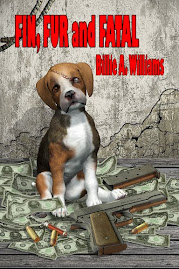
While we are at it I have a new contract as well - My Brothers Keeper a mystery suspense will be released in April of 2012. I'll give you a sneak peak of the cover here.

Hope to hear from you soon

Billie

Tuesday, December 27, 2011

The First Rule of Creativity


Amazon Buy Link
The first rule according to Kurt Vonnegut is Do not use the semicolon. He adds this reason, "...they are transvestite hermaphrodites representing absolutely nothing. All they do is show you've been to college."
In case you don't know what hermaphrodites are - according to the Oxford English Dictionary they are representing themselves as Male and Female - so as with Vonnegut's quote they are nothing - even while they seem to be everything.

The rule of thumb is if MS Word puts in a semicolon rework your writing into shorter sentences--single idea, single topic, simple sentence. Which is always much more affective than a complex multidimensional sentence. Noun + action is the preferred concept.

So spare the semicolon and raise good sentences.
Do you agree with Mr. Vonnegut?

Monday, December 19, 2011

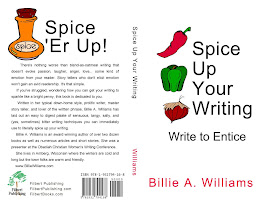
Spice It Up, Creativity From The Kitchen - Spice Up Your Writing, Write to Entice

Order Your Copy Today
Instructor: Billie Williams. There's nothing worse than bland-as-oatmeal writing that doesn't evoke passion, laughter, anger, love…some kind of emotion from your reader. Story tellers who don't elicit emotion won't gain an avid readership. It's that simple.


If you've struggled, wondering how you can get your writing to sparkle like a new penny, or a just cleaned window, learn to see everything as a metaphor for your writing. Start by looking in your spice cabinet, or your herb garden with a fresh perspective.

Garlic, Life Saving but distancing

Easier to write from this perspective but it puts your reader at arm's length--remember readers want to feel, experience, get to be friends with your main character so they can help him/her escape the villains wrath.

Sage, Advice
Sage has several meanings from wise advice to healing properties - what does sage mean to your story? We'll explore.

Basil, The flavor of language, dialect, cultures
Ah Basil - language - should you use dialect in your dialogue? How do you show culture if not through language?


Lavender, Relax feel the flow--in sync [Chat here with a book giveaway as well as a book giveaway at the end]In the flow, relax, meditate let things go where they may--don't lose site of the big picture but let your writing flow with a rhythm and cadence only you can create. Here's how.

Mace, Caustic, self defense, breaking the rules

An irritant chemical, a heavy club with a metal head and spikes - what could these possibly have to do with writing you ask..follow me--it's all about rules.

All Spice, Apple pie or American Graffiti

All Spice is for cookies and more from on genre to another all spice imparts its unique twist, it's unique flavor to your manuscript--your voice. We'll explore more.

Appendix: Handouts, "How to Hook A Reader", "Beginnings to the Work Day By the Masters"

WHEN: Jan 2, 2012 - Feb 19, 2012

COST: $15 for Premium Members

$25 for Basic Members

Cancellation policy: Registrations are non-refundable except when the workshop is cancelled by Savvy Authors.


REGISTRATION: Click Here to Register (Members will not receive member rate unless logged in.)

Sunday, December 4, 2011

Agatha Christie - Contract snafu


The years 1920-1945 were considered the Golden age of British Mysteries, according to John Curran in his book Agatha Christie's Secret Notebooks, 2009. The queen of those mysteries was Agatha Christie. Christie's first novel, The Mysterious Affairs at Styles, took five years from book contract to being published in the UK. The book contract specified she would not receive any pay until 2,000 copies of the book had sold. After that she would get a 10% royalty. That wasn't the only condition though, she was commissioned to write five more novels in the same vein.

Talk about being taken advantage of, luckily Christie learned fast and was assertive. She designed her own contract in subsequent deals and the rest as they say is classic Christie.

Wednesday, November 9, 2011

Chapter Seven

[Actually the last chapter was chapter Six this is the REAL chapter Seven]

Chapter Seven


Jamie was allowed into the property, not that anyone, but the rookie questioned her right to. She needed to get to Ben, hear from him, what he was thinking.

"I'll come in and talk to you and Ben soon as I corral these bees and move them out." Sherriff Hale waved a hand toward the army of the various law enforcement personnel.

Jamie knew they would leave a few to watch the grow until they could harvest it, and plow under any roots—at least she assumed they would. They wouldn't dare burn it. She almost chuckled at that thought. Depending on the wind direction, a bunch of happy folks wasn't necessarily a bad thing…she groaned at her private joke, must be the drive made me slap happy.

Ben sat slouched in his favorite thread-bare easy chair. He didn't look relaxed or comfortable. He jolted to his feet when she entered. His face went from happy recognition to overwhelm with the shadows of trouble. He held his hands out to her.

She didn't know what to say to comfort him, instead she wrapped her arms around him and just held on. "What a mess, hey?" She said finally as she released her grip. Ben backed away nodding his head.

Certainly is missy, and I—" He slumped back into his chair leaving the sentence hanging like laundry on a clothes line blowing in the wind.

"I don't know, I never seen, this mari—weed—whatever –growin. In all my years, I never—well, you know."

"I certainly do know Ben." She sat on the arm of the easy chair and draped an arm over his shoulders. "They'll figure it out. Don't you worry."

Jamie could see slight relief in his demeanor, but he was going to worry. That's what Ben did was worry over everything until he had it resolved to his satisfaction.

:Who found it?" Jamie asked the question she had been wondering since she arrived.

Ben stood up again. This time he began pacing, pinching his lips between forefinger and thumb. "How would he know what it was?" He questioned, the question burned in his eyes a she stared through Jamie—for some unknown answers.

"Who?" Jamie felt she already knew, but where was his nephew if he was part of the investigation?

"B.J. He's the one done found it. He was riding fences, checking the ditches—He--." Ben stopped and turned to gaze out the window. Lost in his own thoughts.

"Where is B.J. now?" Jamie wanted to know if he turned in the find, how could he leave his uncle to face the music alone—BJ wasn't stupid—arrogant maybe, but not stupid she decided.

Tuesday, July 26, 2011

The Painted Pony Analysis of Chapter One

Watch For The Raven


Let's examine The Painted Pony for a minute. Hopefully, without killing the story. As readers and as writers we come to the story with different expectations.

The read in us, swallows up the words a t a pace that's comfortable, digestible and curious about character, plot, setting and depending on the story, a myriad of other details, all perhaps, subconsciously.  If the writer is good, all these things pull the reader, you, into  and  through the rabbit hole of story into a world you, the reader, want to savor. 

As a writer you may enjoy the same joy of reading and yet somewhere you are thinking. Hook, okay, hook is in place. Horses foster a more or less universal interest. Whether it's a wish for the freedom and  adventure of the old west, or a churning desire to lift our head and stir the wind with an abandoned gallop without the tethers of life and its responsibilities. You, writer/reader, may have your own reasons to be drawn in by that first sense of horse and the thunder of hooves shaking the ground beneath your bare feet.

Not only do we know we're observing a painted pony, why not a pinto, is there a difference? Couldn't it instead be an Arabian stallion, or a Clydesdale, the thunder of his/her hooves would certainly rumble the ground if it were a Clydesdale.  For the moment we must assume the writer has a reason for using a paint, over the others. Does it suggest an era, or a custom, or culture?  My mind is drawn to the graphics, hieroglyphics', on cave walls, some, at least, the horses look like painted ponies, is that the reason for this image? My experience and knowledge will try to reason out the choices as critics try to do as they examine works of deceased authors. I never interpreted any of Shakespeare's works the way my high school English teacher did. Does that mean I was wrong?  I don't think so, now, I think my experience, my creative imagination, saw what it could have been when Shakespeare wrote it originally.

Back to our Painted Pony. Immediately the author names the pony so you, the reader, will get a sense of this horse as opposed to any other. Embers, the glowing coals left in a fire, they aren't blazing fire, though, with the right conditions, they could be. And what of Daisy, she loves me she loves me not, wild flower or garden cultivated, again love by many, thrown away as a weed by others. Both horses could show us dual personalities. Is that the author's reasoning?

The third paragraph grabs emotions. Nearly everyone has felt grief. And there are so many sources and depths of grief. What is Jamie's grief? How does Ember trigger this memory? Or, why?  It's obvious, at least to me, horses play a significant role in Jamie's life. The words she, the author uses to describe Jamie's thoughts of horse, delightful creature, magnificent, not beast, but creature—tell the reader subtly how she feels about horses or at least this horse.

Characterization is a tricky business for writers, especially new writers. How do you describe a person without telling? What has the writer shown us so far about our main character. How did it become part of the character Jamie Lynn without becoming description told to the reader?  The first clue is the way you find out about people in real life—it's through their actions. As the old saying goes, "actions speak louder than words."
We see Jamie slide form Daisy's saddle to feel the earth, sensitive to subtle earth changes I think. We learn Jamie is familiar with mountains, especially these mountains. 

Word choice surfaces as we find out Jamie is Native American and that perhaps that has cast a stigma on her development, at least, in part. But now we see her as a business woman in bare feet, riding a horse, chasing or at least following another horse…why didn't she wear cowboy boots or, given her heritage, moccasins? Subtle things develop your character even when written stream of consciousness.
You can list more things we learn about Jamie form this short chapter. What else do you notice as a reader and/or writer? 

Her father's words, what do they add to the story besides word count? Was the message twofold? Does it tell us more about Jamie? And her father? Maybe even hint at the relationship?
The last sentence is the hook that makes us want to turn the page—a child's distress call –why didn't the author use different words, scream, beller, cry, sob, how many synonyms can you think of that could have said similar, if not the same thing?

As writers our tools are words. Precise, words, not flowery (thank you Mrs. Sartorus) words, but precise, strong, colorful, but not gaudy, words that don't parade themselves in front of the reader telling of their literary prowess with a huge vocabulary base, but instead showing the reader what precisely the writer's imagination sees. 

Showing, never telling, never say never-- because there are times when the narrator needs to condense and summarize to move the story forward quickly. We don't need to see Jamie getting her feet wet in the dew laden grass as she goes to saddle Daisy for her morning ride. We didn't need to know Jamie had bare feet. We didn't need to see her saddle Daisy or feed her sugar cubes, not this time. We didn't need to see Jamie's bare feet or any of the earlier stuff to inform our story, but if it had been important to the later story we could have had our narrator tell us all this—otherwise, showing by action, is the preferred and better choice.

As a mystery writer, pointing your reader's mind and eye is essential. You play fair with your reader by directing their attention where you want them to focus, hiding clues in plain sight.
Next we'll try to get our author to turn her muse loose on chapter two.

Thursday, July 14, 2011

The Most Important Sentence In Your Book


Remember the old Peanuts Cartoon? Snoopy, a lovable beagle, wanted to be a writer. There was a recurring story line featuring Snoopy atop his dog house with his old manual typewriter, beginning his book. Snoopy never got further than his opening line, “It was a dark and stormy night.”

The first line is the most important sentence of any book, be it fiction or non-fiction. That first sentence has a big job to do. It must capture the interest of the reader and convince her to read the rest of the first page and then the rest of the book.

Today’s reader is increasingly busy, distracted, and in a hurry. He will not spend time with a book that is boring, hard to read, or needs twenty-five pages to get to the point.
So, what can you do to craft a compelling first sentence?
Follow these steps to make your first sentence powerful:
  1. Don’t worry about your first sentence until you are in the editing phase of your book project. If you are in writing phase, just begin your book and know that you can come back to your first sentence to polish it during editing. If you try to write the perfect first sentence during the writing phase, you run the risk of never moving past it to the remainder of the book.
  2. Pay attention to headlines in news reports, on magazine covers, and on websites. While your first sentence is not a headline, it is the very first experience your reader has of your book so it should be exciting and invite readers to continue. Begin to notice how these headlines are written and see what you can learn from that style of writing.
  3. Is your first sentence boring? Read it aloud and listen. Does it sound compelling? If not, it needs revision.
  4. Next, look closely at your first sentence and see if it generates curiosity. When a reader is curious, she will want to keep reading.
  5. You can elicit curiosity by leading with a surprising fact, a compelling story, a thought-provoking statistic, or by using a metaphor in unusual way.
  6. Read your first page. Find the most interesting piece of information on that page and make that point in your first sentence.
  7. Pare down the number of words in your first sentence so that each word is crisp, clear, and serves a purpose. Shorter sentences convey more energy.
Continue to work on your opening sentence until you feel satisfied with it. When your book moves into publication, your editor will also review this opening sentence and make additional suggestions if more revisions are needed.
Your first sentence is the prelude to your reader’s experience of your book. Invest time in making that sentence shine and your readers will thank you by continuing to turn every page of your book.

Lynne Klippel is a best-selling author, publisher, and book coach who specializes in helping non-fiction authors write books that build their business and transform the world. For a f.r.e.e. assessment that will help you see your author strengths and opportunities, visit http://www.BusinessBuildingBooks.com

Monday, July 11, 2011

Old Presidents and Old Leather Journals


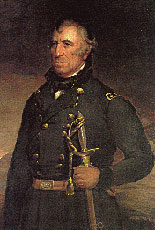
Zachary Taylor, 12th President of the United States. The silk bookmark I found in an old leather bound journal indicated he was inaugurated March 5th, 1849 and died on July 9, 1850. What made this even more eventful for me was I found this bookmark on July 9, 2011. One hundred sixty-one years after his death. The book mark was fading and the ends were frayed, but it was still beautifully preserved.

My mystery writer's mind wondered that he died so soon after he was inaugurated, he was only 66 years old. I suppose that was old for back then, but still. How did he die?  Apparently he had helped dedicate the Washington Monument earlier that hot and humid July. Just like it is today. The heat got the best of him and he retired to his quarters early to eat a bowl of cherries and drink a pitcher of milk.

Much controversy over the slavery issues of the time made him a candidate of much ridicule and argument. Did someone poison Zachary Taylor?  Or was it, as one doctor presumed some intestinal infection that did him in? Will we ever know?  I wonder? 

The bookmark and the leather book came from an estate Sale, my mother and my sister used to do estate sales near Detroit, Michigan many years ago. Upon investigating the book further I see that it was made by The New Departure Manufacturing Company, of Bristol Connecticut.  And it was called a Business Year book.  The cover, raised relief pictured scroll work and the name Mr. A Moorhouse in gold-foil inlay lettering graced the front of the journal, the edges were also gold.  I hesitate to deface the pages with my small successes; you see I had planned to use this as a success journal. I would imagine the empty journal, obviously, being housed in a leather zippered stationery holder, complete with writing surface and ink blotter, places for pens, and seals and perhaps postage of some sort, perhaps a stamp or embrossed signature press , gold –foil embrossed in the name of Albert C Marshall are two separate pieces of two different people's lives that really don't matter to anyone any more.  

 I could use it – If I dared. There are so many interesting features in the back matter of the book – a perpetual calendar 1756-1956, Leap years 1756 – 1952, parcel post zone rates – for example a one pound local package would cost you five cents…out to the 8th zone it would cost you twelve cents. What can you mail for twelve cents today?

Each page of the journal has a tiny box that you can place a check mark next to the type of weather for that day-- clear, cloudy, rain or snow. There is a place for addresses, Insurance Expiration dates and other particulars about the policy, 

The American Creed by William Taylor Page, Business Laws, points of constitutional Laws, fifteen don'ts in the use of the American Flag and the fourteen errors of life – by Judge Rentoul as told to the Bartholomew Club(I'm not sure what that was.)
The rules as listed:
Remember these are errors:
1.       To expect to set up our own standard of right and wrong and expect everybody to conform to it.
2.       To try to measure the enjoyment of others by our own.
3.       To look for judgment and experience in youth
4.       To endeavor to mold all dispositions alike
5.       To expect uniformity of opinion in this world.
6.       Not to yield in unimportant trifles
7.       To look for perfection in our own actions
8.       To worry ourselves and others over what cannot be remedied.
9.       Not to alleviate if we can all that needs alleviation.
10.   Not to make allowances for the weakness of others
11.   To consider anything impossible that we ourselves cannot perform.
12.   To believe only what our finite minds can grasp
13.   To live as if the moment the time, the day were so important that it would live forever.
14.   To estimate people by some outside quality, for it is that within which makes the man. "London Standard." 

The Journal's forward first paragraph. "Nothing is new except that which has been forgotten," we will regard the passing of the old ear and the coming of the new one as simply a matter of looking at the calendar, for isn't it true that whatever is, functions as a merger of what has been with what is to come.
The ball bearings this company designed, which also designed and, I suppose, presented this business journal to its employees was:
 New Departure Mfg. Co
De Witt Page, President
Bristol, Connecticut
December 26, 1924

How neat, maybe I will make good use of this journal after all. It will house my successes and help me keep my bearings.


Monday, July 4, 2011

Golden Living - Writers Recital


Amberg Writers Group Recital brings writing to the Golden Living Center in Florence, Wisconsin


On Tuesday June 28, 2011 The Amberg Writers Group lead by Billie A Williams presented a 'Recital' at the Golden Living Center in Florence, Wisconsin.  Dance recitals, piano recitals and now writers reading their original works in a writer's recital. 

A group of more than twenty people participated in the event.  Laughing about readings of traveling on rocky roads and Yorkie dog antics,  " yellow" the one word prompt, the man or dog with the red whiskers drew first nervous stirrings, and then laughter at the surprise ending, personal miracles brought, sighs of reverence and loud applause, and a story about a book suitable for every person that entered a book store story surprised and delighted. The actual 1904 book presented and showed words that seemed to suit, randomly telling each person exactly what they needed to hear. A poem about Makeup inspired with its ending twist that makeup can't hide, or make more beautiful, what's inside a person. 

Representative of the readings, treats in the form of 'cup cakes' were the container to serve up  the dog bone cookies, yellow/orange circus peanuts, a quarter for those less fortunate and other goodies distributed from the writers to the residents and staff of Golden Living. 

The drawing for prizes that consisted of an autographed copy of July Heat, and one of Money Isn't Everything written by Billie A Williams (as well as a copy donated to the home's library), angels, pet rocks, a bag of 'yellow' goodies, notebooks and pens, t-shirts and book bags.  All the prizes were in some way representative of what each writer read about.

The writers group consists of, mostly unpublished writers—if you consider only book or magazine publications. However, some of these writers have published in trade magazines and newspapers. The online branch of this group contributes their writing even though they can't be present to attend the 'recitals' someone else reads their work.  Some of those members can count book publications and publication in anthologies such as the Chicken Soup for the Soul books. 

The group is available to do 'recitals' for other groups that might be interested, so far besides the nursing home, this has included library visits, but they are open to more venues. The presentation consists of original works by the writers constructed from prompts such as: "expect miracles", or 'yellow', or maybe "an abandoned tricycle" always a new prompt each month.  The results are always a distinctive blend of uniquely different stories developed by the individual writers.

As the group practices with their writing prompts constructing short 250 to 500 word stories, they are beginning a new venture--they all are beginning their own full length fiction manuscript. The genre chosen by most, so far, is mystery. Some are working on memoirs in addition to the fiction book. 

Everyone is welcome to join the group, age, writing or publishing credits do not matter. No previous skills are necessary just a desire to write. 

"Writer's Write" is the group motto.  "Write Like The Wind," or "Write Like Your Fingertips Are On Fire," are the group mantras.
For more information contact:
Billie A Williams,
P O Box 134
Amberg, WI 54102