Showing posts with label improving your writing skills. Show all posts

Monday, December 3, 2007

The Glass Mountain


“My mood is the glass mountain of fairy tale lore! I slither down every time I try to clamber up.” Julia Cameron

As writer’s we expect those days when the words just won’t fall to page in the manner we hoped. When we’d rather pull the rabbit hole we’ve fallen into down with us and never view the light of day or the page again. When the wind blowing the new fallen snow across shoveled pathway creates drifts and magical pyramids in its wake, we want to be swallowed up in the white-out. But we clamber up out of that black hole, we clamber back up that slick glass mountain, we push and fight to get out from under the drift and we do write again even better than before.

Elisabeth Kubler Ross says, “…live each day…as if it was the only one we had.” And to do that we need to climb up, dig out, and scale the mountains in our path or roadway. If we don’t write it no one else can. Our uniqueness is unique only to us.

Two writers writing side by side with the same three-word prompt will never have the same story even if they write elbow to elbow. I read somewhere that our attitude creates our altitude, so if we are to scale great mountains of glass we will need to adjust our attitudinal course.

One way to plow through the snow drifts of our fear, our refusal to write, our writer’s blocks is to just write. Ribe Tucus! Butt in chair and write. We eventually can write through that drift as if the pen were a snow plow or shovel. We can climb over that glass mountain as if we had diamond studs in the tip of our pen and our cleated shoes. It takes courage to write in the face of great obstacles, but once begun, the writing will solve its own road blocks, its own mountain or snow drift.

“Freedom means choosing our burdens,” Hephzibah Menukin told us. If our burden is to write and we choose to accept it by picking up the gauntlet in the form of pen or keyboard, then we must WRITE ON!

Billie A Williams
Award-winning, multi-published author
Accidental Sleuths who solve crimes with wit, wisdom and chutzpah
Writing instruction books written in byte sized, portable prose.
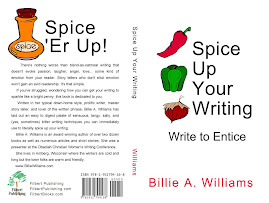
Spice Up Your Writing, Write to Entice
ISBN 978-0-6151-7533-1
To see more go to
http://www.lulu.com/content/1349866
http://www.billiewilliams.com/

Saturday, December 1, 2007

Snow Use Procrastinating


"Ideas are a dime a dozen...it's the passion that publishers are looking for." Says one writing guru. That is so true. If you start your story out with and idea and six little key points you will be ready to roll.

What are those key points? Do you remember the journalist questions you were told to answer? try this on your story before you begin writing.

Who
What
When
Where
Why
How

That's it. And after you get that written you just fill in the holes. Sounds easy doesn't it? I have written three books that will help you do that. Put them on your Christmas list and you'll be ready to roll by January 1st.

Writing Wide, Exercises in Creative Writing
ISBN 1-4137-0092-6 [Filbert Publishing.com]

Characters In Search of An Author
ISBN 978-1932794151 [Filbert Publishing.com]

Spice Up Your Writing! Write to Entice
ISBN 978-0-6151-7533-1 [LuLu.com]

These are sure to get you started and help you keep going. So all you need to do is add your own passion by writing about something that moves you deeply. It may be a mystery that has other reasons for being, domestic abuse, drug abuse or some other social ill. It may be a non-fiction book, a cookbook, a how to craft or garden book, it may be a poetry book--but if you add your need, your zest, your personal fingerprint to it -- it is a sure fire winner.
Good Luck!

Friday, November 30, 2007

Nano WHAT?


Nano – What?
by Billie A Williams

I mention NaNoWriMo to my friends or family and they say “Nano WHAT? I tell them it’s the National Write a Novel in a Month challenge – and they roll their eyes and say “right”.

It may sound funny, but its some dead serious writing with a lot of fun thrown in. Can you write 50,000 words in 30 days? Sure you can. You could take the dictionary off your shelf and copy words steadily until you reach the magical 50,000 words and then you could cut and paste it into the NaNoWriMo challenge submit page. Since you scramble the page anyway, it might work. I haven’t had the time to test that theory. But hey, all the words you’ll ever need you’ll find in the dictionary – so you could conceivably do just that as long as you formed them into sentences and paragraphs. Question is, why would you want to. That would be like writing the worst trash you could think to write in the length of a novel manuscript and submitting it to Publish America just to see if it would go through. Or doing one of those lovely graffiti paintings on the box cars you see going by. Why not instead channel that talent and make it pay off. Do the real thing and test yourself against -- who? Your own self of course.

I learned a lot from my fourth year of doing NaNoWriMo. The most important thing is that I can do anything I set my mind to. I also learned to let the editor sleep late while I get the words down on paper. I learned that I can compose at the computer; I really don’t need to write it all out in long hand first – which cuts my writing time nearly in half.


Is the writing as good or better? I haven’t edited the first 54,000 words yet so I can’t say for sure. What I can tell you is that it felt incredible when I got the letter from Chris Baty (whose dream child this whole program is) that says CONGRATULATIONS you made it. The whole letter makes me want to giggle. It does a lot of saying you are one of a kind, you beat the odds when others didn’t. He’s right! Not every one who entered made it to the end, some didn’t even get half way—I did. That says something about my responsibility, my commitment, my perseverance—that says I have what it takes to do what I say I am, to do what I really want to do. It says I AM A WRITER!

I’m guilty of having an inferiority complex, an introverted sense of myself and I’m shy beyond all belief. NaNoWriMo gives me courage. I’ve had two books published from the three years I’ve done NaNoWriMo so far. I plan to submit the one from this year too as soon as I finish it. That should take me a couple more weeks.

If you don’t do the NaNoWriMo challenge, try this instead. Challenge yourself to write just one page a day. Do you realize that in 365 days you will have enough pages for at least two novels or one 365 page Harry Potter or regency romance type novel. Pick up the gauntlet, challenge yourself. If you are a writer, put your fingers to the keyboard and prove it.


A writer writes, that’s all there is to it. A writer doesn’t talk about what s/he’s going to write. A writer doesn’t say s/he has this great idea for a story s/he’ll write when the kids get bigger, the weather is better or worse, the job slows down. A writer writes over, above, around, under, beyond, or through whatever is in her/his way. If I did it you can too! WRITE ON!
Tomorrow I will post an unedited chapter from The Capricorn Goat. My novel from NaNoWriMo this year. Come back to read it and let me know what you think.
Billie

Tuesday, June 26, 2007

Live Longer, Live Better, Volunteer


Want to live longer?
by Billie A Williams

I’ve heard this before but for some reason it stuck with me today when I read it. When you volunteer you’ll get more than you give. One of those things you’ll get according to a recent study – is a longer life.

“Research on volunteerism shows that people who volunteer live longer, have stronger immune systems, have fewer heart attacks, recover from heart attacks faster, have higher self-esteem, and have a deeper sense of meaning and purpose than those who don’t volunteer.” Jack Canfield wrote in his book The Success Principles.

What does it cost you to volunteer? Commitment, a tiny bit of your time, perhaps some change, perhaps a little money. What can you gain besides a longer, better life? Everyone needs to feel needed (wanted) they want to belong according to Abraham Maslow and his hierarchy pyramid. What better way to be in that position than to help others.

There’s another thing, you can learn from volunteering. There are companies that take on summer volunteers – think of that as FREE training/learning. You can enhance your skills for the type of job you are seeking by volunteering to ‘help’ at a company that may need summer extras – and you will learn. Perhaps when they decide to hire a new employee you’ll be on their mind.

As a writer think about volunteering at your public library or your school. You could read to the students. Help them find things to write about for a creative writing class. Visit classrooms to speak. Everyone is in awe of a REAL writer. They want to touch your pen, shake your hand, pick your brain—and think of all the stuff you’ll learn. Especially, if you write for children or teenagers—it’s all there in a class room full of energy.


Carry that one step farther, read at a local nursing home or assisted living facility. The tome of information availble from the senior citizens that live in these places is unequalled. Tap into this rich resource while you give of yourself, you may be amazed at what you gain in return.

You want to write ad copy — or articles, or biographies, or feature articles, profiles, be a journalist? Go volunteer your services at your local newspaper. Even if it’s stuffing Sunday editions with the junk mail that comes in them — you’ll learn. Being in a newspaper environment is a key to succeeding in these fields.

Where you volunteer you’ll learn to talk the talk and walk the walk – all of it for no cost to you. Rewards as big as all outdoors are yours for the volunteering. How about being a camp counselor, or a park visitor greeter. Park Camp Ground supervisor…all fodder for stories.

Next time you need to research, consider volunteering, the benefits are huge.

Sunday, June 24, 2007

Vocabulary Isn't Just for 5th Graders


VOCABULARY ISN’T JUST FOR 5TH GRADERS

I was reading a promotion from a master marketer by the name of Michael Masterson -- his emails are tomes of information and it takes time to digest them. Lately I haven't had much time to do that.

Today, his missive was about vocabulary and the benefits of having a good base vocabulary of your own. Of course, I jumped on it with both feet since words - the love of words - is one of my hobbies. When you are a writer, finding the exact right word is paramount to getting your thought across precisely and perfectly. But, what else does a good vocabulary do for you? In a recent study here is part of what Masterson found out:
"...In fact, it doesn't matter how sophisticated you look, how stylish you dress, how elegant you appear. Without a polished vocabulary, the doors to success are shut tighter than Scrooge's cash box.

Think I'm exaggerating? Not in the slightest. Here's why...

The esteemed Stevens Institute of Technology ran studies on what made someone successful. What they found surprised even them. It wasn't physical appearance, it wasn't family connections or even financial backing.
It was how a person spoke - and the words they used. Simply put, it was their vocabulary"

So you see it isn't just writer's that need a strong vocabulary. He did go on to say you don't need to use 25 thousand dollar words where a nickel one will work - you just need to be able to understand what someone is saying to you so that you respond appropriately. Doing that ensures your success, relieves you from the fear of embarrassment. Using a word for which you don't understand the meaning is failure waiting to happen.

I guess that's why I love MyDictionary.com daily new word - they aren't always words I want to memorize, but some seem to stick in my head when I'm writing and pop into my writing. I always check their meaning with my MSWord thesaurus as I edit--but generally they are right on or a better word is supplied because I put the first one into the thesaurus.

I have made a habit of writing down the words in a notebook kept on a shelf by my computer that I may use sometime in my writing -- every once in a while I go through the notebook just to see what I have. It sparks my muse if nothing else.

Studying words, doing crosswords--even if you look up the answers--is a great way to increase your vocabulary. As writers, WORDS are our stock in trade, after all.

Friday, June 8, 2007

Using Articles to Drive Traffic to Your Site


Writing to Help Others Can Help You Brand Yourself.
by Billie A Williams ©2007
(Small Town Secrets - January 2008 - ISBN 978-1-59705-283-2 )http://www.wings-press.com

The internet is full of content starved web masters, newsletter publishers and ezine operators always looking for your articles if they will increase the publication’s value to its readers. This is a win win situation. As you help others, you help yourself. How, you might ask.

If you include a link in your signature line, a link back to your website people who see your name on articles time and again begin to trust and rely on your word. They’ll want to check out your web site to see what else you are about.

Spend some time looking around the various article directories. See what people are writing about. Can you contribute something similar? You know things that no one else knows because your words are colored by your experiences, your life. You are unique and therefore, anything you write will have your personality all over it. This is more or less branding you – like a Campbell soup label, no one needs to tell you who that is — a Pepsi label no one needs to tell you who that is. You become similar when people see your name and your articles they feel like they know you personally.

You don’t need to be a literary genius – if you wrote a book you have expertise – you had stick-to-it-ness. You started some how, you wrote pages and pages to finish a book length manuscript. People – your readers— want to know how you did that. Where did you get your idea, how did you keep at it in spite of rejections (and we all get those). Think of the tons of questions you had as a newbie to the writing craft. What did you want to know? Now you are the expert, you can help others by telling them what you know in an article.

Your web site (You do have one don’t you? You should if you are hoping for a career in writing.) is full of ideas to write about. If you have a bio page, go through it — what have you done, what do you do? Do you have a day job? There is a wealth of information on your own website. Use it to create articles.

What was your book about? How did you find that information to make it appear real? Are you an amateur detective? How did you get to be that, did you take courses where, how long did it take you? If you aren’t, where did you get your idea and how did you expand on it? If you talk of abuse, are you a victim, have you worked with victims in your other life? Who did your book cover, did you have input? How did you decide on what you wanted? What is the process you used to get from page one to “the end” and did you have a cover in mind before you started? Some people are visual, they see a picture and they have a story – is that you or how did you ‘see’ your cover and when?

As you can see there are a million questions readers and would-be-writers would love to know. You can use that to help them, help other publications as described above and help yourself. That sounds like a winning situation all the way around to me.

Feel free to use this article as long as you leave the writer’s resource box below intact. Thank you.
Billie A Williams Accidental Sleuths solve crimes with wit, wisdom and chutzpah
http://www.billiewilliams.com/
http://printedwords.blogspot.com/
writer’s group http://www.word-mage.com/

Sunday, June 3, 2007

Editing or Typo Hunting, What's the difference?


THE FRUGAL EDITOR,
Put your best book forward to avoid humiliation and ensure success.
by Carolyn Howard-Johnson
ISBN 978-0-97851-7-4
Red Engine Press
Reviewed by Billie A Williams

In this day an age when, according to some studies, over 81 percent of Americans feel they should write a book and more than six million of them actually have at least written the manuscripts. What are your chances of getting published when that is just over two percent of the population? Most of these manuscripts however, are doomed to failure because they don’t understand the intricacies of polishing (read that as editing) their manuscripts before sending them out, and/or hiring an editor to give it the final tweak before they send them off.

According to a recent article by Robert McCrum in "The Observer" and I quote,
“…according to the New York Times, there's a new book published in the United States every half an hour, and - wait for it - that's just fiction. RR Bowker, the company that compiles the Books in Print database in the USA, has calculated that no fewer than 175,000 new titles were published in 2003. That's one book roughly every 20 seconds.” As you can imagine that trend has only increased since then. As McCrum says, the new books have the shelf life of yogurt, but that quality will always stand above the rest and will persevere. So how do you bring that quality to your own work?

The Frugal Editor by Carolyn Howard-Johnson is like having an editor in a box, or more correctly, between two covers of a book. Concise down-to-earth advice about how to edit your manuscript before you even begin to think about sending it out into the red pencil world of publishers, where their editors get the first chance to evaluate your hard work.

Frugal Editor is a veritable thesaurus of how to spot the gremlins that can mess up your prose. If edits and editors paralyze you with fear, take heart. Carolyn Howard-Johnson makes the whole process palatable. She intersperses her directives with light hearted humor making the whole process nearly enjoyable.

If there is an error your manuscript could contain, you’ll find the method for search and eradication in this delightful book. You’ll want to read it cover to cover, but then you will keep it by your side as you write, rewrite and edit so you can be frugal when you do decided to hire that editor to give it one last polish before you submit it anywhere. As Howard-Johnson says; “The lesson here for all of us is that attention to detail and craft counts, and that even experienced writers can flub an opportunity if they don’t pay attention to the last great step toward publishing, a good edit.”

Howard-Johnson explains the difference between and editor and a typo hunter. She also cautions that “…no matter how skilled an editor is, the author needs to know a lot about the process too. The cleaner the copy you hand over to your editor, the more accurate she can be and her edit may cost you less in time and money.” When Howard-Johnson says frugal in her book titles she means it and she goes to great lengths to insure the reader gets her/his money worth by providing resources with links, examples of the often scary Query letter construction, and more. She doesn’t leave the reader high and dry at any point. Further advice or learning is a matter of using the comprehensive index to find the detail you need and then following the advice, link or resource mentioned to guide you in your search for excellence.

The twenty plus pages of appendices is not mere fluff or padding of book length or word count, it is more than a bibliography of recommended reading (though it also contains that). You will find samples and links such as the query letters mentioned above, helpful groups to investigate, grammar helps and books. It’s hard to believe more could be contained in any book on your shelf. Spare no gremlin—search and destroy, polish and perfect before you send out your hard work. This book is the tool to help you do that. I highly recommend this power house of methods and means that will not only enhance your chances of publication, it will help you make any publishing house sit up and take notice – perhaps even pushing your book to the coveted best-seller lists faster than you ever imagined.

Friday, May 18, 2007

Is All Feedback Equal?


WHAT ABOUT FEEDBACK?
WHAT ABOUT NEGATIVE FEEDBACK?
by Billie A Williams ©2007

We have a tendency to think anything negative — is—well, negative. Did you ever stop to think that it probably has more to do with YOUR attitude than the feedback? Jack Canfield has been my mentor this week, as you no doubt can tell, and boy does he ever change your attitude about things.

Let’s take negative feedback – such as we might get with a rejection. What if you were to take a look at that rejection, that negative feedback and say: “Hey, this is information that I can use. This is information about an improvement opportunity.”

Say what? An improvement opportunity? Ask yourself these questions.
Does caving in and giving up gain you your objective, your goal?


No it keeps you stuck in the same place you were before you got it.


Does getting mad at the source of the feedback pull you out in front of the pack?
No—it pushes the person away from you. They tried to help or tried to guide you and you rejected them as a person instead of looking past the anger to see what they were saying.


Does ignoring the feedback get you closer to your goal?


That is a loaded question because you do need to weigh the feedback you are getting. If it seems right, after you analyze it in a non-combative state of mind, then you owe it to yourself to incorporate it into your path toward your goal.

You need to think of feedback as correctional guidance, as a steering force in your pursuit of that brass ring – whether that is publication, an agent, a 6-figure contract with a big-name publishing house or the New York Times Best-Seller list

Be willing to ask for feedback. If you don’t ask for it, you may be missing the opportunity to improve what you have. Make a good novel great—a good attempt a breakout best-seller. Don’t be afraid to ask. When you do ask LISTEN with all your heart and mind. “Feedback is the gift that helps you be more effective,” says Jack Canfield.

He also cautions that not all feedback is accurate. One test he recommends is looking for patterns. If several people are telling you the same thing you may as well accept that there is likely some truth to it. Would you rather stand your ground and feel you are right? Or, would you rather be successful? Accept feedback, use it to build by reconstructing, re-thinking what you are trying to do.

Responding to being off course, or your reaction to that feedback…So what do you do once you get some feedback?


Acknowledge and accept that you actually did the best you could with what you had at the time. That includes your skills, your knowledge, and experiences.


Look back on what you have done so far. You survived. You can cope with the end result so far…you have finished your manuscript, it needs work – you can survive that. You can re-do with constructive feedback, make it what you thought you had created — a piece of work that will garner respect and admiration for your talents.


Write down everything you learned from the experience, your insights, your lessons and ways that you can do it better next time. Or, in the case of this manuscript tweak it until it sparkles with your very best work.


Now here is a biggy!


Thank everyone for their feed back and insights. Gratitude is the most significant Karma you can cultivate. If that feedback is hostile feedback, use what you can and dump the rest, but thank that person for their time, and consideration, their willingness to give you their opinion.


Another caveat, do not try to hide failure. Clean up the mess, apologize if it’s necessary – and move on. This probably would apply to other areas more than writing except if you’ve done sloppy research and purported facts that weren’t true etc.


Take time to go back and review your successes. Sometimes, negativity seems to hit you below the belt and you owe it to yourself to review the good that you’ve done and do. Regroup and spend time with some positive, loving friends, family and coworkers who can reaffirm your worth and contribution. The very fact that someone likes and cares about you is enough to rebuild your faith in yourself.
Now that you’ve wallowed in some good vibes its time to refocus on your vision, your dream, your major goal. Incorporate the lessons you’ve learned. Recommit to a new plan of action to get you on course and out there. You are ready – so do a Nike™!


JUST DO IT!

Wednesday, May 16, 2007

Perseverance


Perseverance
And your first line
by Billie A Williams © 2007

Spending a lot of time on that first line, that first paragraph — the hook of your story-- Is it worth it? Compare what you have come up with now with that of a couple authors and we’ll look at something that speaks of perseverance and polishing, and pushing through to get there.

Michael Crichton wrote State of Fear, here is the first line from that book.
“In the darkness, he touched her arm and said, ‘Stay here.’ She did not move, just waited. The smell of salt water was strong. She heard the faint gurgle of water.”

We talked about that first line before. Well ,what we didn’t discuss before was Michael Crichton’s career. He won both Emmy and Peabody awards. Crichton created the TV show ER and his books have sold over 100 million copies in 30 languages, 12 were made into films and he directed 7 of them.

Crichton’s books and films include: Jurassic Park, The Andromeda Strain, Congo, Twister, and Westworld to name a few. He was the only person in the United States to have the number-one book, the number-one movie and the number-one television show all at the same time. That is some kind of record to emulate, wouldn’t you say?

“Books aren’t written—they’re rewritten,” Crichton says.

That may be true. Ernest Hemmingway wrote Farewell to Arms 39 times (or should I say re-wrote) before he was satisfied that he had ‘gotten it right’. Let’s look at his first sentence in that book.
“In the late summer of that year we lived in a house in a village that looked across the river and the plain to the mountains.”

Is that enough to pull us in? Sure, we think 'so what?' and 'What year?' But is it enough? Hemmingway probably knew it wasn’t. But the rest, the first paragraph, speaks to us further, let’s read on.

“In the bed of the river there were pebbles and boulders, dry and white [emphasis mine] in the sun, and the water was clear and swiftly moving and blue in the channels. Troops went by the house and down the road and the dust they raised powdered the leaves of the trees. The trunks of the trees too were dusty and the leaves fell early that year and we saw the troops marching along the road and the dust rising and leaves, stirred by the breeze, falling and the soldiers marching and afterward the road bare and white except for the leaves.”

This paragraph presents a nearly ominous feeling of troops marching and leaves falling early. Is he hinting that the men who marched by were too young to fall like the leaves off a tree early—early in their lives? He starts and ends the paragraph with the “dry – and white", then bare and white”—neatly packaging what he wants us to see and feel.


If Hemmingway could rewrite A Farewell to Arms 39 times to get it right, what makes us think our first draft is perfect, what makes us think once is enough? Not that we should be paranoid and never let go, never finish tweaking. You need to be satisfied at some point. But working on it is never a waste of your time.

Another example of going the extra mile, persevering, for your career is M. Scott Peck – his non-fiction book—The Road Less Traveled — he believed so strongly that it was a good book worthy of being read and re-read he invested himself in the marketing and promotion of it by being interviewed on 1,000 radio shows in the first year after it was published. Did he stop there? No, for the next 12 years he did at least one interview a day at the minimum on radios wherever he could.

His book hit the New York Times Best-Seller list and stayed there for over 540 weeks (a record) selling 10 million copies in over 20 languages.

I venture to extrapolate that the messages here are perseverance pays off whether it is in tweaking your story for the 39th or 100th time, or getting out there and hawking your wares once it is published.

If you want to succeed in this game of becoming a highly successful author you have to walk the walk and talk the talk, but then you have to get out their and promote until you make it. INVEST IN YOURSELF! As Mark Joyner would say “Hit it until you hit it!” or put another way “Fake it until you make it!” as Wayne Dyer says.

Monday, May 14, 2007

LIVE LIFE INTENSELY/FULLY

LIVE LIFE INTENSELY
by Billie A Williams © 2007

“For your writing to have depth, you must experience life to the fullest.” [Rob Parnell, www.easywaytowrite.com ]

Does that mean you have to go out and sky dive even though you are afraid of heights just so you can write well? I think not! I doubt even John Grisham or Patricia Cornwell have sky dived. Your background can provide a rich tapestry from which to draw or intense fantasies provide varying degrees of depth and intrigue to your writing.


For instance fantasy author Brenda Kleager isn’t satisfied to sit and dream up fantasy worlds – she is continually experimenting with new ideas, new venues—researching and developing her worlds, her characters. And, when she is not designing characters or worlds, she designs jewelry and book thongs and more for authors [ http://www.treasuredsecrets.info ], or she is writing books on natural/holistic topics. She is a teacher, she is a mother, she is a student, and she can move across town or across states without taking a second to pause for a breath. In my book, she is a prime example of living life intensely, going for the brass ring every day in everything she does. She is the Literary Specialist (Little Professor) at
www.word-mage.com/ offering her abilties to help others.

As writers we come to discover, writing itself seems to add intensity to our lives. The very act of thinking on the page, developing characters to people our stories, designing plots to wrap around the guidelines of the genre we are patterning our story to fit, personal growth, achievement and spiritual fulfillment help to develop the writing and the person/author.

Dealing with rejection takes a certain kind of chutzpah and writers become adept at handling it and moving on. That takes intense living. Believing in yourself enough when some others don’t seem to, takes a certain kind of courage and perseverance. It is an experience, it is growth and it is living without walls when you defy that rejection and dare yourself to try one more time.

Think of yourself as Einstein – not 10,000 failures but 10,000 experiments that didn’t yield the desired outcome—yet! If dyslectic Einstein can be an inventor of great things, how could one little rejection stop you who are living intensely, while wringing every drop of power out of every second of life?

Becoming a successful writer is the ultimate gamble as you risk your self-esteem, your livelihood, your ego on the belief that you can succeed. Living life intensely doesn’t need to be living recklessly; it just means challenge yourself to do the thing you fear. Stretch yourself, to do the thing that helps you grow, helps you gain experience that can be used in your career. Fear is the energy for change that fuels your growth. Fear nothing.

There is a saying around that “nothing is wasted on a writer” and I think this is true. What other profession lets you use every single thing that— rules your day, or spoils your mood, or elates you, or crashes your dreams, yet allows you to further your career? Live it for all you are worth, whatever the day may bring and you will be living your life intensely. Look at those dreams in your background while you were still young enough to dream, before someone told you you couldn’t, that it was a foolish waste of time – dream again—it isn’t a waste of time – it’s time moving you to stretch and try and be all that you can be! YOU’RE UNSTOPPABLE! Live your life that way.

Friday, May 11, 2007

HABITS FOR WRITERS


I could put a number in front of that title— say-- 10 habits or whatever – but why would I? If you’ve followed my blog for long, you know that I say “Successful Writer’s Write Every day" no matter how they feel, what’s going on in their day, or if they don’t have a pencil to their name. Anyone who wants to be a writer will talk the talk, and walk the walk. So if I were numbering these points I would call number one the “Develop the will to write daily,” priority, number one on your to do list – Let's start by calling it what I prefer to call it, your goals list.

Everyday you meet people who say "I want to write a novel. I have this great idea," yet they never sit down to get page one started. As Rob Parnell ( www.easywaytowrite.com ) has said on numerous occasions “If you want to write novels you have to start NOW [emphasis mine] immediately, and not put it off any longer."

In this world ,we can save money for a rainy day – but we have not found out how to save/bank time for when we want it at some future date – NOW is all you have. If not NOW, When?


Setting goals for yourself is one way to get a finished project. Say you agree to write three pages a day – hey, if you do that everyday, you’ll have nearly 1,100 pages in a year – that could easily equal three novels.


Be sure when you are involved in that goal setting that you commit to finish projects. Getting 300 books, or articles, or essays started—does not equal a finished, saleable project. Check those idea faeries at the door. Write down their intrusion with a great idea and then continue on to finish your current project before you grab up one of her sparkling new ideas.

It has been said that it takes 21 days to create a habit. My challenge to you is, if you want to be a writer – write at least three pages every day for the next 21 days. Pick a time convenient for you —morning, evening — it makes no difference when. What does make a huge difference is that you do this. Twenty-one days isn’t a long time, it isn’t a month, it isn’t hardly worth mentioning time-wise, but once you do it—you have formed a valuable HABIT, a precedence, a ritual, a practice, which will eventually get you to your goal of becoming a writer, perhaps even a published author.

So get started today. What have you got to lose, except perhaps your fear of getting started.

Saturday, April 28, 2007

A 12 Step Program For Writers


12 Steps for Writers
Steps to letting yourself know you are serious about being a writer
by Billie A Williams© 2007

Step 1
Admit you are a writer, and then believe it. Tell everyone who asks, what do you do, who are you? “I am a writer”.
“Conceive it, believe it, achieve it.”

Step 2
There is a belief circulating that says if you tell the universe what you want — “I want a book deal with a six figure income attached to it. I want to be rich and famous as a writer.” it will happen. If you say it long enough, loud enough and clear enough it will begin to come about.

“Conceive it, believe it, achieve it.”

Step 3
Recognize that writing is more than words on paper. It is entertaining, or helping, or creating respite for some weary soul. Writing means I can entertain without being an entertainer. I can share from the privacy of myself. I can create an income that keeps coming and I can leave a legacy behind. I can be proud of my accomplishments. I’ll have tangible evidence that I am a writer. More and more people are shadow or closet writers because they do not get the support and encouragement of family, friends or peers. It would seem that writing is not a legitimate work — It is! And you need to believe that. You need to have enough chutzpah to say, “I AM A WRITER.” It is hard work, a work that we love, but grueling sometimes despite that love.
“Conceive it, believe it, achieve it.”


Step 4
Set two goals to accomplish in the next 30 days. Write them on your calendar. Check in to see how you close you are getting. – If it helps write daily and weekly goals that pull you closer to accomplishing those goals in 30 days.
“Conceive it, believe it, achieve it.”


Step 5
Tell your goals to a trusted friend – verbalize what it is you really want to have done in 30 days. Your friend can help to keep you on task if you report in once a week. Maybe have a breakfast or lunch date to chart your progress.

“Conceive it, believe it, achieve it.”


Step 6
Be prepared to act. What are you willing to do to achieve your goals? Action and attitude will go along ways to helping you be perceived as a ‘real’ writer. If you want to have people take you seriously you have to talk the talk, but you also have to walk the walk.
Words without action are moot, the serve no purpose.
“Conceive it, believe it, achieve it.”


Step 7
I’ll say it again verbalize and validate. Do something to move you to that goal – if you are to be a writer you must write. You cannot of have written, until you write—until you do your time at the keyboard or with pen and paper and then submit that writing to the outside world. Not for judgment, but for approval, for validation that you indeed are a writer because you write – because you want to make a living doing what you love to do.
“Conceive it, believe it, achieve it.”


Step 8
What’s holding you back? What is it that you think you don’t have that will make your efforts viable? If you make excuses, any excuse will do. No time, no money, no place to work, the kids, spouse, neighbors are interrupting all the time. There is no excuse if you want something badly enough, you will find a way. When was the last time you wanted something so bad you could taste it? What did you do to move the mountains out of your way to get it? Did you sit around and visualize yourself having it or did you put you feet on the ground and push to get it? That’s how it is with writing, you will never FIND time you have to make it. You have to set rules for yourself and your environment. Then you have to put your behind in a chair and get to the hard part—the writing. As they say, “the proof is in eating the pudding,” you’ve heard that I’m sure—no matter how good it looks on the outside – once tested can it live up to your expectations. In other words you can say you are a writer all you want, proof that you believe this is what you need.
“Conceive it, believe it, achieve it.”


Step 9
What can be done? You’ve shored yourself up, you’ve told everyone you are a writer — now you need to prove it to yourself and your friends, relatives and peers that you honestly are. So what can you do? Better yet what will you do now?
“Conceive it, believe it, achieve it.”


Step 10
Re-evaluate your feelings, your dreams and your goals. Are they in line with the real you, the writer you? Are you comfortable with the way they are stated and will you begin today to move toward them acting appropriately, pursuing them with all your might?
“Conceive it, believe it, achieve it.”


Step 11
Sharing time with other writers will go a long way to help you build your own momentum. Taking writing classes, workshops, going to conferences, or retreats will move you closer to your goal. If you are uncomfortable spending so much time alone, join or form a writers group to support your efforts. These groups can be online or in person, it all depends on you and how you want to pursue your goals.
“Conceive it, believe it, achieve it.”


Step 12
Spread positive Energy. Surround yourself with people who are full of energy and happiness. Those who are comfortable with who they are and what they are doing with their lives will add fuel to your energy. They will help you to see your potential and to realize you can be a writer. You will walk the walk. You are a writer.
“Conceive it, believe it, achieve it.”


SEE IT! BELIEVE IT! ACHIEVE IT! YOU ARE A WRITER!

Thursday, April 19, 2007

Excuses Don't Make You a Writer


Last week we interviewed two writers. We got in touch with how they work. You can bet they don't make excuses for anything. With that I had a few thoughts about "Real" writers and excuses that don't make you a writer.

Neither, do writers make excuses. If you are serious about the craft of writing you must internalize the phrase, “Writers Write.” Above all else they write every day. Never allow yourself to say you are too tired, too busy, you’re waiting for inspiration or you’ll do it tomorrow. If nothing else begin with a double spaced page of I can't write now because - keep writing until you talk yourself out of all those silly excuses.

A real writer won’t give up because editors, agents, readers, critics and publishers are unfair and they just won’t give a new writer a fair shake. Think of all the breakout novels that have hit the stands lately – oh sure everyone thinks Harry Potter or Eragon, or any other list that includes a new author is just a lucky break, the author must have known someone. The truth is the break out author, or the over night success has paid the his or her dues, writing through problems of single parenting, home schooling, and a myriad of other things they could have used as excuses. If they weren't writers. Remember excuses don't make you a writer and writers don't make excuses.

Oh I’m too young, old, or I come from a poverty background that doesn't allow me to be able to “waste” my time sitting around writing everyday. (what about J.K. Rowling) Or my family always interrupts me with something I “have” to do, so I don’t have “time” to write. You are creative, that’s why you want to write; so, create a plan that lets you write at a time when interruptions are minimal. If that means late at night or the wee hours of the morning, if you really want to be a writer —you will find an appropriate time and place to write. You will ask your spouse or significant other to deal with things for an hour while you write. You'll tell your children you need a few private minutes to write and you'll play a game (or whatever is their favorite thing) with them if they will give you an hour. Set a timer so they know you mean business.

“Writers write; everyone else makes excuses,” says Jack M. Bickham the author of more than sixty-five published novels and a plethora of other publications on the craft of writing fiction.

Pick up your pen and write! I challenge you to this: buy a calendar – a cheap one with large squares you can write in. At the end of each day write down how many hours you actually spent writing—-[no research is not writing] follow that with how many pages of product [page]you have. It doesn’t have to be a polished manuscriptpage; it can be rough a draft page or several. The important thing is that you produced some writing. Do you realize if you wrote one page a day for a year – you would have the equivalent of a 365 page novel? So what are you waiting for?

Friday, April 6, 2007

Sharpening My Pen With Maple Sap

I know that sounds silly - but it's the truth. This morning as I was looking out my window on this unusually blustery and cold spring morning the birds were flocking to the feeder and the suet in record numbers. The poor little guys must have been freezing. The Gold Finch are molting and getting spring yellow wardrobes and that makes them particularly vulnerable. I feel sorry for them.

I started writing about this in my journal (my three long hand morning pages everyday) when I noticed an odd phenomina. There were frozen icicles of sap dripping from the soft Maple tree that stood a few feet from the bird feeder. The black capped chickadees and the rose breasted nuthatches took turns drinking the frozen brew. The chickadees had to hover like humming birds, the nuthatches just perched upside down and nibbled at leisure.

The three families of woodpeckers (downy, hairy, and I'm not sure what the other is, small, medium and large all look pretty much the same - except to another of their specific species I'm sure.) were joined by a yellow bellied sapsucker all taking turns on the suet or hammering the tender maple branches and I knew instantly who had wounded the Maple tree causing the sap to flow on the days when the sun shines. Even if the wind and the temperature are cold...the warmth of the sun encourages the Maple to do what maples do. The woodpeckers do what woodpeckers do and the result is a special treat for the other birds. Mother Nature is amazing.

So, my writing practice included lessons in letting go and letting nature take its course. Sometimes that is necessary in our own lives too.

Enjoy your Easter break - hope your holiday - if you celebrate is filled with love, health and prosperity, and do take time to look out your windows and be amazed.

Wednesday, March 28, 2007

A Picture is Worth a Thousand Words, even to a writer

Increasing your Writing Skills is about writing, but no one says a picture can't spark that writing. The Old adage that a Picture is Worth A Thousand Words maybe be true even for writers. Give it some thought - can you take a picture and make it live for your readers? Look for a magazine or calendar picture that really grabs your attention. We call this an image driven story prompt.

Now, take that picture focus on it for a minute or longer. What do you see there. What message does it send to you? Write what it draws from you for about ten minutes. I know another ten minute thing, but seriously, it usually takes that long to get to the message - to clear the chaff and get to the wheat so to speak. Give it a shot, you may turn up with a great piece of writing, if not - ask yourself what failed to happen. Were your words too trite, did they fail to evoke the meaning the picture held for you? Why?

Try this; if there are people in the picture, what are they thinking about? What are they talking about? How did they get where they are? Who are they? Why are they there. Go the journalist route who, what, when, where, why, how?

If there are no people in this picture, someone had to take the picture. Who, and why did he/she take this particular picture? You will be surprised how much you can wring out of this picture when you ask deep questions.

Another trick is like the two year old who just found out about questions - keep asking why, until you run out of any possible thread to explore.
Hope you have fun with this exercise to increase your writing skills.
visit me at my website www.billiewilliams.com
or my Word Mage Group at http://yahoogroup/group/word_mage
or the Word Mage website at http://geocities.com/wordcrafter123
Keep an eye out for Joyce Anthony, Author of Storm - guest blogger coming soon.

Saturday, March 24, 2007

Words - trite or true

"As a writer, teacher and former editor, I wince in horror. Spelling isn't "if it feels good, do it." Spelling is precise, and if it isn't, the writer comes across as incompetent, and the manuscript gets tossed into the reject pile more times than not."

There are as many views on this topic as their are colors in Crayola's biggest new box and more--blended, shaded and just plain interpreted in someone's native tongue...So what's the answer?

"I often use spellings that have some meaning to me. That is : I always use grey in describing a soft color as in grey velvet but when something is ominous like a darkening sky I use gray. To me blond is just a haircolor but blonde is a person with great beauty. We as writers have the option of using whatever spelling that conveys the meaning of our words.Go for it." says FoxLady, Dee Carey

So it sounds like we can't just use what we chose - but I'm all for using concise, precise words to say what I mean. I've been a blonde all my life - well until I got some grey (or is that gray?) mixed in there - I learned a gray squirrel is gray -- a cloud can be gray - or white and fluffy...but does that make me right? Only in the country where I use it -- USA - the Brits have a whole 'nuther point of view and spelling for a lot of words which are perfectly correct over there. So, who's to be the judge?

I guess, when it doubt check the latest issue of The Associated Press Stylebook, Chicago Manual of Style or some other source to be sure you are using correct spelling. If your editor says -- wrong word spelling choice -- you better believe you should go with her/him...if you want to be published by that particular publication or with that publisher that is.

But then again, that is just my humble opinion on a very broadly discussed topic. What do you think?

Friday, March 23, 2007

What's a Metaphor - not a meta tag but a metaphor

We are looking at ways to improve our writing skills. Here’s another. You’ve all heard of metaphors haven’t you? My dictionary describes them this way:
Metaphors: A figure of speech containing an implied comparison, in which a word or phrase ordinarily and primarily used as one thing is applied to another.

Try this: On the left side of a piece of paper list tangible nouns (touchable) like flood, cement block, fork, spoon, knife, ocean, steam engine, snow flake— you get the idea. Then on the right hand side list of the same sheet of paper list intangible nouns (things you can’t touch like ideas) such as silence, respect, hunger, tired, beauty, nice, cold,

Got them – I hope you added more than just what I have listed, but even if you didn’t try taking a tangible noun and combining it with an intangible noun to make a metaphor of you own.

How about this: Spoonful of respect, or Ocean of desire, steam engine of lust….okay your turn. Let’s see what you can create.

If you get some you like, why not share them in the comments below and we’ll have a creatively unique pool of ideas to use to spark our writing with new metaphors. Go ahead give it a whirl, you don’t have to be a poet to speak in metaphors.